








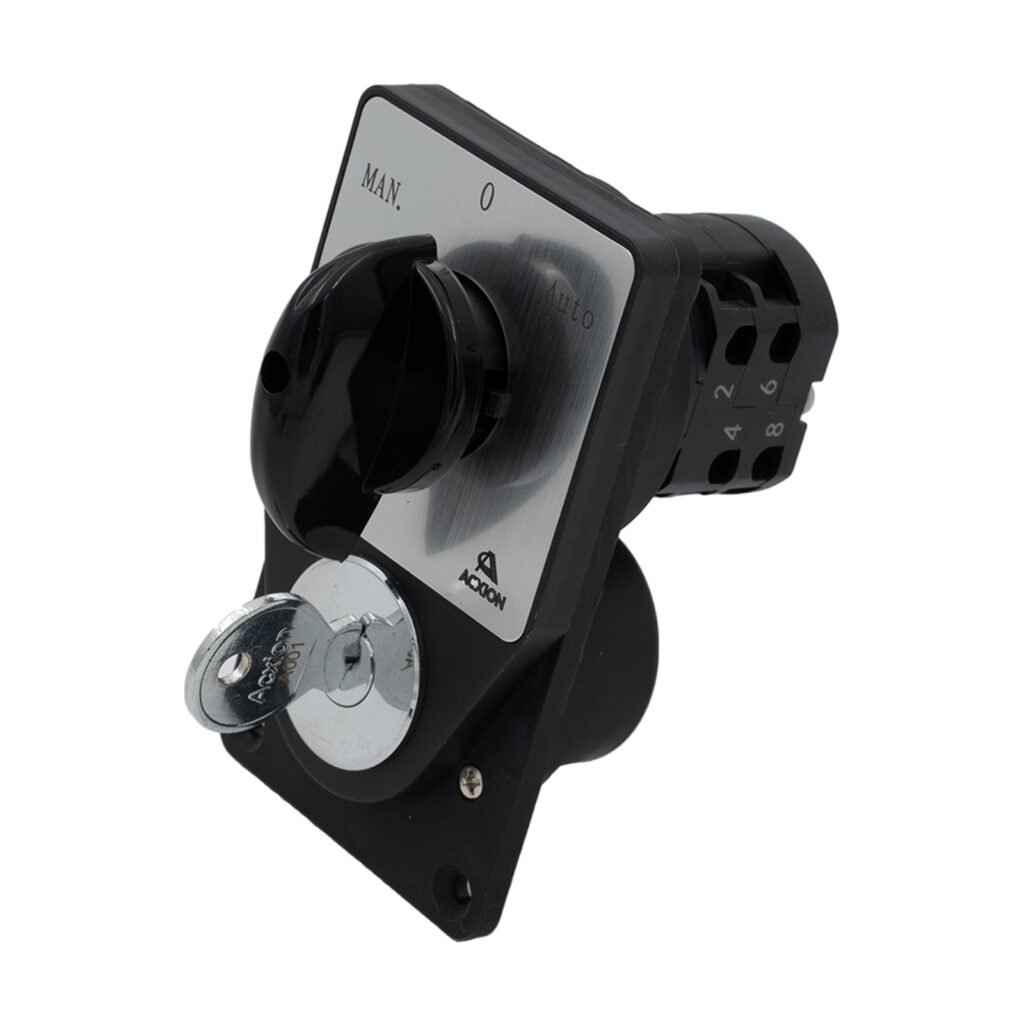
If you’ve ever opened an industrial control panel and seen a rotary knob labeled LOCAL – REMOTE, OPEN – 0 – CLOSE, or MAN. – 0 – AUTO, you’ve already met a cam switch doing its job. Quiet, mechanical, and dependable — these devices handle some of the most demanding switching tasks in motor control without a single line of code.
But not every cam switch is right for every motor application. Choose the wrong one, and you’re looking at contact welding, premature failure, or a safety incident. Choose correctly, and you get a component that outlasts the panel it’s installed in.
This guide walks through what engineers and panel builders actually need to know when specifying cam switches for motor control — from load types and current ratings to wiring configurations and certification requirements.

Why Cam Switches Belong in Motor Control Panels
Before we get into selection, it’s worth being clear about where cam switches genuinely excel — and where they don’t.
Cam switches are manually operated, multi-position rotary devices. A rotating shaft moves cam profiles that engage or disengage spring-loaded contacts in a precise, predetermined sequence. There’s no coil, no PLC, no relay logic. Just a handle position that directly defines the circuit state.
For motor control, this is a significant advantage in several scenarios:
Forward/Reverse control. To reverse a three-phase motor, you swap two phases (typically L1 and L3). A 3-pole reversing cam switch does this in a single turn, with an OFF position in the middle to prevent direct phase-to-phase switching while the motor is running. No contactor, no interlock relay — just the cam profile doing the work mechanically.
Star-Delta (Y-Δ) starting. Large motors drawing 5–7× full-load current at startup can overwhelm a direct-on-line configuration. A star-delta cam switch steps through the starting sequence — Star, transition, Delta — reducing inrush current during startup. The cam profile ensures the correct contacts close in the correct order, every time.
Mode selection. MANUAL – AUTO – TEST, or LOCAL – OFF – REMOTE. These selector positions don’t carry motor current directly, but they define the control path. Cam switches handle this kind of low-current logic switching reliably across hundreds of thousands of operations.
Isolation for maintenance. Before servicing a motor, an operator needs a clear, visible means of isolation. A cam switch in the OFF position is unambiguous in a way that a software-controlled relay is not.
That said, cam switches are not contactors. If your application requires hundreds of thousands of electrical switching cycles under full inductive load — as in a motor started and stopped dozens of times per hour — a contactor is the right tool. Cam switches for motor control shine where manual, multi-position operation is required and where switching frequency is moderate.
The Four Specs That Matter Most
1. Rated Current and Utilization Category
This is the most common source of specification errors.
The current printed on a cam switch nameplate is its thermal current (Ith) — the maximum continuous current it can carry without overheating. This is not the same as what it can safely switch under load.
For motor control, the relevant rating is the AC-3 utilization category, which covers switching of squirrel-cage motors: closing on inrush (up to 6× FLA) and breaking at running current. The AC-3 rating is always lower than the Ith rating.
Practical rule: For a motor with a 10A full-load current, specify a cam switch rated for at least 16A in AC-3 duty — not just 10A thermal. The inrush current at startup will stress contacts far beyond the running current.
For purely resistive loads (heaters, lighting), the AC-1 rating applies and is closer to the thermal rating. For highly inductive DC loads, derate further.
When comparing cam switches across manufacturers, always compare the same utilization category. An AC-3 rating of 16A and an Ith of 25A are very different numbers — and both may appear on the same datasheet.
2. Number of Poles and Positions
Three-phase motor control typically requires a 3-pole switch — one pole per phase. But the number of positions depends on the application:
| Application | Positions | Poles |
|---|---|---|
| Simple ON/OFF isolation | 2 | 3 |
| Forward / OFF / Reverse | 3 | 3 |
| Star / Transition / Delta | 3–4 | 6 |
| Mode selector (Manual/Auto/Test) | 3 | 1–2 |
| Voltmeter/Ammeter selector | 4–5 | 1–3 |
For star-delta starters, the switch needs to handle both the star winding configuration and the delta winding configuration across separate contact blocks — typically requiring 6 poles across 3–4 positions with specific make-before-break or break-before-make sequencing built into the cam profile.
This is where working with an experienced manufacturer matters: the cam profile is a physical design decision made at the factory. Unlike a PLC, you cannot reprogram it in the field. Provide a complete switching table before ordering — specifying which contacts should be closed in each switch position.
3. Voltage Rating and Insulation
Standard industrial cam switches are rated for 690V AC, which covers most three-phase industrial systems worldwide. However, always verify:
- Rated insulation voltage (Ui): The maximum voltage the switch can withstand without breakdown. Should exceed your system voltage with appropriate margin.
- Rated impulse withstand voltage (Uimp): Relevant for systems subject to transient overvoltages (lightning, switching surges). Typically 6kV or 8kV for industrial panels.
- DC ratings: If you’re working with battery systems, EV charging infrastructure, or photovoltaic applications, verify the DC voltage rating separately. DC switching is harder on contacts than AC because there’s no natural current zero crossing.
4. Mechanical and Electrical Endurance
Mechanical endurance (no-load operations) is typically rated at 500,000 to over 1 million cycles for quality industrial cam switches. This figure is largely irrelevant in motor control contexts — the limiting factor is almost always electrical endurance: the number of on-load switching cycles.
Electrical endurance under AC-3 conditions typically ranges from 3,000 to 20,000 cycles depending on current level. For a motor that’s manually started and stopped twice a day, that’s years of service. For a motor started 20 times per shift, plan for more frequent replacement — or reconsider whether a cam switch is the right device.
Common Wiring Configurations
Forward / OFF / Reverse (Motor Reversing)
The most requested wiring for cam switches for motor control. A 3-pole, 3-position switch swaps L1 and L3 between the forward and reverse positions:
- Position 1 (FORWARD): L1→U, L2→V, L3→W
- Position 0 (OFF): All contacts open
- Position 2 (REVERSE): L3→U, L2→V, L1→W
Critical: always pass through OFF when changing direction. Never switch directly from FORWARD to REVERSE — the motor inrush during direction change will far exceed contact ratings and can cause contact welding.
Star-Delta Starting
A 6-pole cam switch handles both the main contactor function and the winding configuration:
- Star position: Motor windings connected in Y, reduced voltage across each winding
- Off/transition position: Brief interruption to reduce current spike
- Delta position: Motor windings reconnected in Δ, full voltage for running
The cam profile must ensure the star contacts fully open before the delta contacts close. This break-before-make requirement is built into the cam design — verify it with the manufacturer’s switching diagram before commissioning.
Ammeter / Voltmeter Selector
A common application for panel metering: a single meter reads multiple phases via a selector switch. Note that ammeter selectors must never open while current transformers are energized — the cam profile for ammeter service requires make-before-break contact sequencing to protect the CT from open-circuit overvoltage. This is a different cam design than motor reversing applications.
Environmental and Certification Requirements
The international standard governing cam switches for motor control is IEC 60947-3, covering low-voltage switchgear and controlgear for switch-disconnectors and load switches. Any cam switch used in a compliant industrial panel should carry third-party verification to this standard.
Beyond IEC 60947-3, consider:
- CE marking for equipment sold into European markets
- CCC certification for equipment installed in China
- UL/CSA for North American markets
- IP rating for the operating handle and panel cutout — IP65 is typical for outdoor or washdown environments
- RoHS compliance for end-products sold in regulated markets
Don’t rely solely on self-declared compliance. Ask manufacturers for test reports from accredited third-party laboratories. At ACXION, our cam switches carry more than 200 certifications across global markets — because our customers need documentation, not just claims, when they submit panel designs for approval.
What to Ask Your Supplier
Before placing an order for cam switches for motor control, get clear answers to these questions:
1. Can you provide the switching diagram (contact truth table)? This table shows which contacts are open and closed in each switch position. Without it, you cannot verify that the cam profile matches your application.
2. What is the AC-3 rated current, not just the thermal current? Many suppliers quote only Ith. The AC-3 rating — which accounts for inductive motor loads — may be significantly lower.
3. Are replacement contact blocks available? In heavy-use applications, contacts wear before the mechanical body does. Modular cam switches with replaceable contact blocks reduce lifecycle cost significantly.
4. What is the terminal wire range? Confirm the switch terminals accept your conductor cross-section. Industrial motor circuits often use 4–10mm² conductors — verify the terminal can accommodate them without requiring ferrules or reducers.
5. Can you accommodate custom cam profiles? If your application has a non-standard switching sequence — as is common in specialized industrial machinery — confirm the manufacturer can produce a custom cam profile and provide documentation for it.
A Note on Quality Tiers
The global cam switch market includes products at very different quality levels, and the differences aren’t always visible in a photo or a spec sheet.
The areas where quality gaps appear most often in cam switches for motor control:
Contact material. Silver-alloy contacts resist oxidation and handle arc energy better than plain copper. Look for silver or silver-cadmium-oxide (AgCdO) or silver-tin-oxide (AgSnO₂) contact materials in the product specification.
Cam profile tolerance. A poorly machined cam can fail to fully close contacts, creating resistance at the contact interface that generates heat under load. This failure mode appears gradually — early in the product life, resistance is marginally higher than spec; later, it causes thermal damage.
Housing material. High-temperature thermoplastics (rated to 125°C or above) resist deformation near heat-generating components. Lower grades may soften in close-mounted panel configurations.
Terminal design. Screw-clamp terminals with anti-rotation features maintain clamping force better over time than simple screws on flat conductors, particularly in vibrating environments like compressor rooms or mobile machinery.
At ACXION, we’ve manufactured cam switches since 1991 with full in-house control from injection molding and contact stamping through assembly and testing. That vertical integration means we control the variables that matter — not just assemble purchased components.
Selection Checklist
When specifying cam switches for motor control, work through this checklist:
- Motor FLA and utilization category (AC-3 for squirrel-cage induction motors)
- Required switch positions and their circuit states (get a switching table)
- Number of poles required
- System voltage (AC or DC, voltage level, Uimp requirement)
- Required certifications for the end market (CE, CCC, UL, etc.)
- IP rating for the installation environment
- Expected switching frequency (to assess electrical endurance requirements)
- Conductor cross-section for terminal compatibility
- Availability of replacement contact blocks
Getting these parameters right before ordering prevents expensive rework and ensures the switch performs reliably across its expected service life.
ACXION (Jiangsu ACXION Electric Co., Ltd.) has manufactured industrial switching components since 1991, with customers in more than 50 countries across power distribution, elevators, EV charging, energy storage, and industrial automation. Our cam switches are available in standard and custom configurations, with full documentation packages for international panel approvals. Contact us to discuss your application requirements.