








Software interlocks are great—until they aren’t. In modern industrial automation, we’ve grown accustomed to relying on PLC logic and digital communications to prevent catastrophic operator errors. But when a processor faults, or when a network cable is inadvertently unplugged during a night shift, the last line of defense between a running 1000kW motor and a confused technician isn’t a line of code. It’s a piece of metal.
This brings us to an often-overlooked aspect of panel building: the physical architecture of state selection. Specifically, how we use hardware to force an operator to make a deliberate, conscious choice before altering a machine’s operational mode.
The Problem with “Soft” Interlocks
Consider a standard Local/Off/Remote control scheme. If this selection is handled entirely by a digital HMI touchscreen, any number of anomalies—a corrupted memory register, a frozen UI, or a simple backlight failure—can leave the system in an ambiguous state. The operator thinks they’ve selected “Off,” but the controller still registers “Local.”
This is exactly why veteran engineers specify hardware-based mode selection for critical functions. But a standard maintained switch isn’t always enough. In high-vibration environments or heavy-machinery applications, a simple spring-loaded mechanism can degrade over time, leading to physical “drift” between positions.
Enter the Double-Latching Mechanism
To eliminate this ambiguity, the design philosophy shifts toward mechanical certainty. By utilizing a double-latching architecture, the switch physically locks the cam and contact block into place at each detent. It doesn’t rely solely on spring tension to maintain its state; the internal mechanics actively prevent the rotary mechanism from creeping from “Position 2” to “Position 3” due to external vibration or minor impacts.
For a practical application of this, look at how a 2NO Three-Position Double-Latching Rotary Selector Switch functions in a real-world distribution panel.
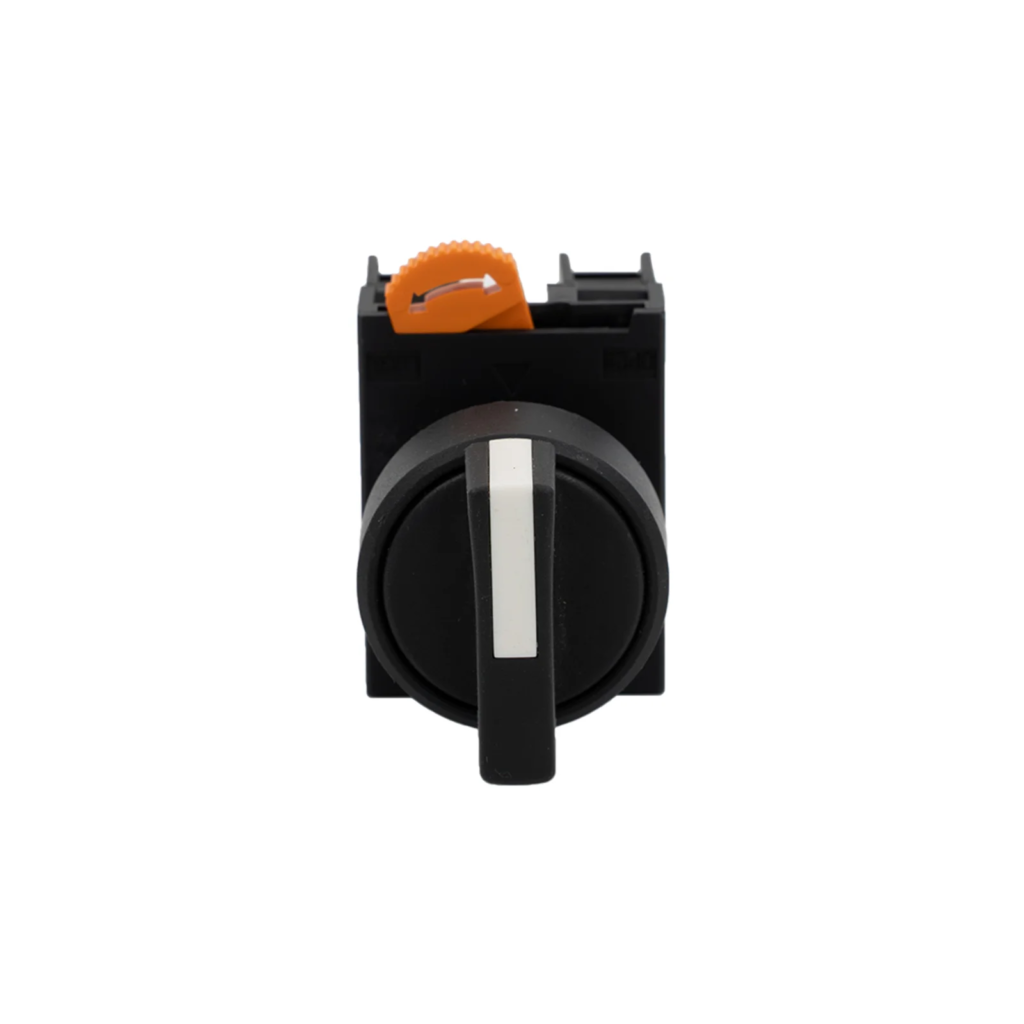
Notice the 2NO (Two Normally Open) contact configuration. This is a deliberate engineering choice. Instead of a single pole handling the mode change, the 2NO setup allows the switch to independently trigger two separate circuits simultaneously. In a pumping station, for instance, turning the switch to “Position 3” (Remote) simultaneously closes the circuit enabling the remote SCADA start command AND closes an auxiliary circuit sending a hardware “Remote Mode Active” feedback signal to a separate safety relay. This dual-circuit confirmation ensures that the system cannot inadvertently enter a half-state.
Why Three Positions Matter in Real Operations
A two-position switch (On/Off) is binary and often insufficient for complex maintenance protocols. The middle position in a three-position design acts as a hard mechanical neutral.
Imagine an elevator maintenance scenario. The three positions might represent: Inspection Mode | Locked Out | Normal Operation. When the technician inserts the key and physically turns it to the center “Locked Out” position, the double-latching mechanism bites down. The elevator controller is hard-wired to disable all automatic movement. Even if the building’s fire alarm system tries to recall the elevator to the ground floor, the physical 2NO contacts are broken. The software demands movement, but the hardware says no.
Selecting for the Inevitable
We design control panels not for the days when everything runs smoothly, but for the moments when things go wrong. When you specify a mode selector, you aren’t just buying a way to change circuit states; you are buying a physical gatekeeper.
Choosing components with robust double-latching mechanisms and redundant contact arrangements ensures that when a frantic operator runs up to a panel during a fault condition, the switch will be exactly where they left it, indicating exactly what the system is doing. No ambiguity, no drift, no software workarounds. Just the mechanical truth of metal against metal.