



The show closes in Jakarta today, and the most photographed thing on our stand was not a screen. It was a black board with seven product families bolted to it and a row of catalogues standing behind. Visitors kept asking the same three questions, and the layout was built to answer them without a salesperson standing there.
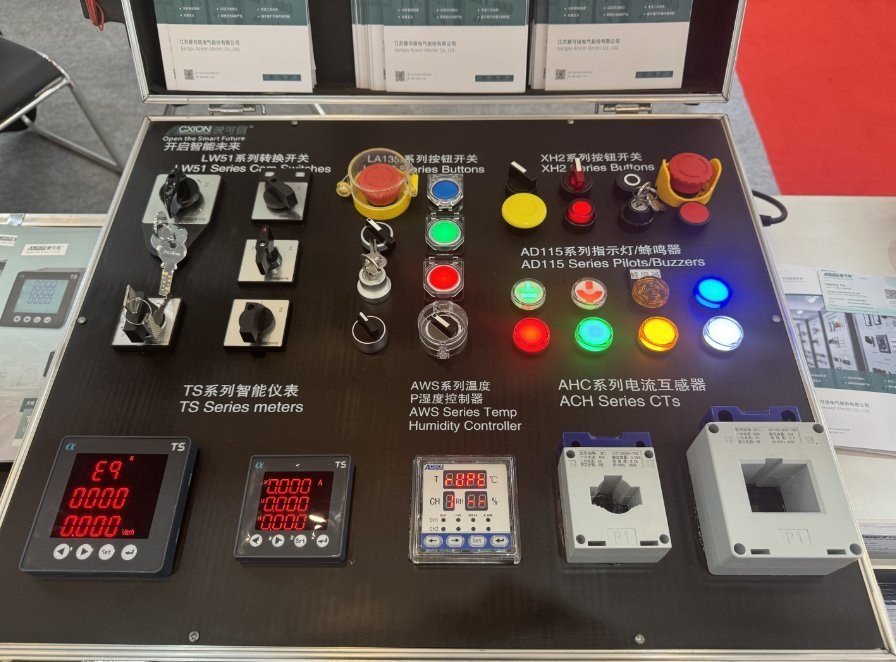
So here is the board, family by family, with the ratings that matter. We build these products, so read the selection advice with that in mind. All numbers below come from the catalogues on the stand or from what the demo board itself was reading.
Scope note: this covers low-voltage panel components for control and distribution boards up to 660 V. Medium-voltage switchgear protection is a separate product group with its own rules.
How the board groups the panel components
Look at the layout and the logic is visible. The top row is everything an operator touches: cam switches on the left, push buttons in the middle, pilot lights and buzzers on the right. The bottom row is everything that reports back: two TS meters, an AWS temperature controller and two ACH current transformers.
That split answers the first question we get at every show, which is where a part sits in the panel rather than what it costs. If you are holding a drawing and trying to place a component, the board mirrors the drawing.
Switching: LW51 cam switches, 10 to 20 A
The key-operated switches in the top left corner are from the LW51 platform. It is a configurable rotary range rather than a fixed catalogue of three models.
- Current frames: 10 A, 16 A and 20 A
- Operating angles: 22.5 to 90 degrees
- Contact sections: up to 16, depending on frame and type
- Rated insulation voltage: up to 660 V, model dependent
- Control supply: up to 380 V AC at 50/60 Hz, or 220 V DC
- Power-frequency withstand: 2,500 V AC RMS for one minute
- Reference standard: GB/T 14048.5 / IEC 60947-5-1
The service life figures are worth reading before the model list. They decide whether a switch suits a machine or a distribution board. On AC duty the figure is 200,000 electrical operations. On DC it is 100,000. Mechanical life is 500,000 operations. Operating conditions are Category III, pollution degree 3, minus 25 to plus 55 degrees C, altitude up to 2,000 m.

Configuration follows a fixed order: duty first, then positions, angle, mounting, contacts, and finally the panel and marking options. Putting looks before electrical duty is how panels end up with a switch that cannot break the load it was bought for.
Operators: LA135 and XH2 push buttons
Two push button platforms were on the board. They serve different panel habits. LA135 covers a compact 16 mm platform and a modular 22 mm platform.
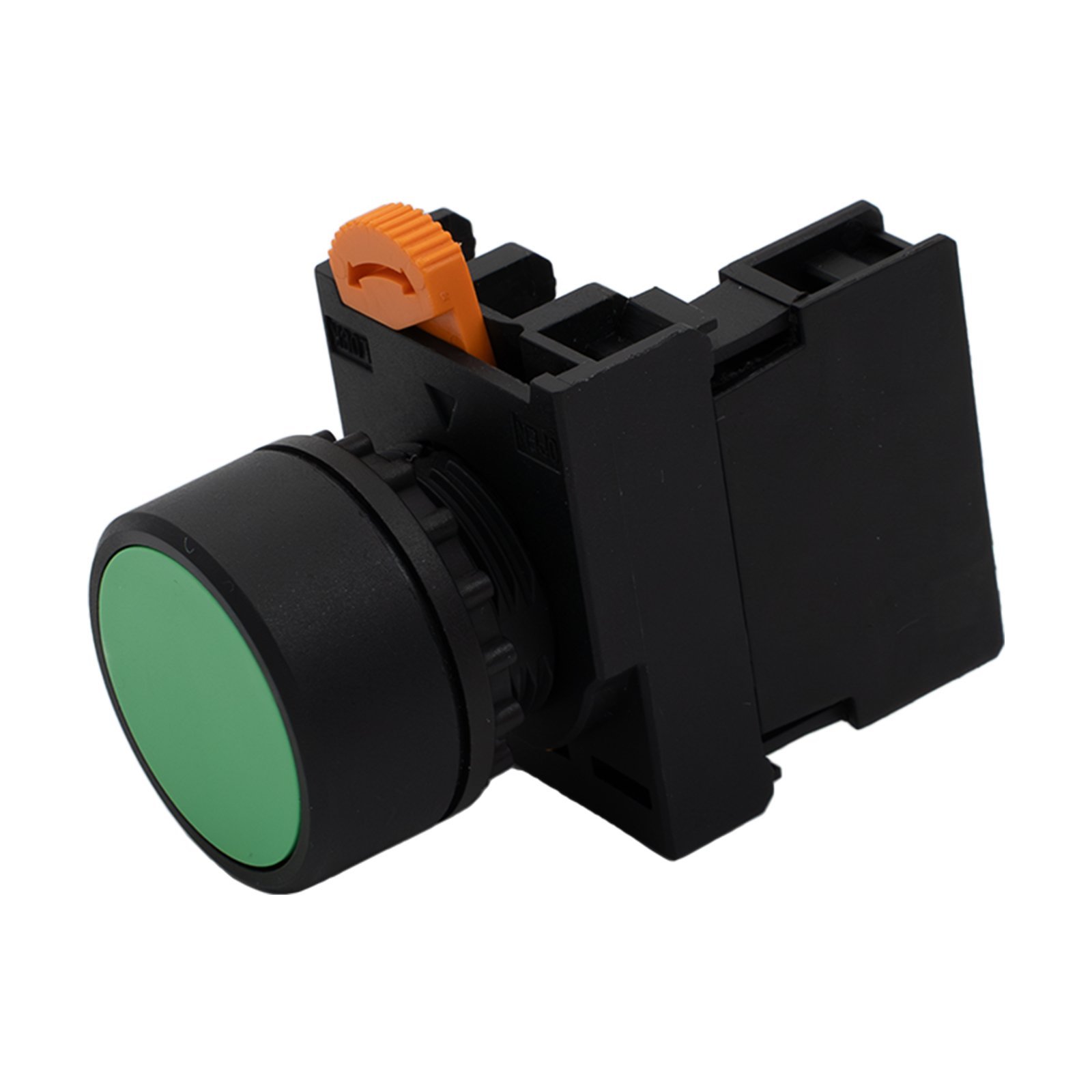
The ratings differ, so mixing them up matters. The 16 mm family runs Ui 250 V and 5 A conventional thermal current, with 1,500 V AC withstand. The 22 mm modular family runs Ui 400 V and 10 A, with 2,500 V AC withstand. Both list IP54 front protection with selected IP65 options, and an IP67 waterproof cover is available in Ø22.
Life ratings on LA135 are worth noting. Push buttons reach 1,000,000 mechanical operations. Selectors reach 200,000. Electrical life is 500,000 and 100,000 respectively. The ordering code carries the contact arrangement, head shape and protection level, so LA135-11/10C1 is a round momentary button, 1NO plus 1NC, IP54.
XH2 is the heavier-duty side of the range. Its technical page is the one visitors photographed most.
- Standard: IEC 60947-5-1 / GB/T 14048.5, with CCC and CE certification
- Ui / Ith / Uimp: 600 V / 10 A / 6 kV
- Mechanical life: 3,000,000 operations for momentary buttons, 500,000 for key switches, 100,000 for latching, mushroom and selector types
- Electrical life: 100,000 operations, 1,000,000 customizable
- Operating frequency: 3,000 cycles per hour for momentary, 1,800 for latching, selector and key, 600 for emergency stop
- Front protection: IP65 standard, IP66 customizable
- Vibration 5 g at 5-50 Hz; shock 15 g, 11 ms half-sinusoid
- Operating temperature: minus 25 to plus 70 degrees C
The 3,000,000 figure tends to stop the conversation. It applies to momentary buttons only. It is a mechanical figure from the standard’s test sequence, not a promise about contact wear. The electrical number is the one that decides maintenance intervals.
Indication: AD115 lights and buzzers
The lit column on the right of the board is the AD115 platform. A red lens module sat loose next to it, so visitors could see the internal LED block.
- Mounting diameters: 16 mm, 22 mm and 25 mm in one series
- Light source: high-brightness LED, 30,000 hours or more continuous
- Voltage range: AC/DC 6 to 380 V, with selected AC configurations extending to 500 V
- Power-frequency withstand: 2,500 V AC RMS for one minute
- Insulation resistance: 5 MΩ up to 60 V, 50 MΩ above 60 V up to 660 V
- Front protection: IP54, IP65 customizable, salt-spray-resistant versions available
- Vibration: 10 to 2,000 Hz, 1.5 mm, 10 g
- Operating temperature: minus 25 to plus 50 degrees C
Beyond the standard round, square and rectangular indicators, the range includes bi-color, flash, semaphore and position types. The position versions show disconnector and ground symbols rather than a plain light. Buzzer variants combine audible and illuminated alarm in one cutout.

Measurement and monitoring: TS, AWS and ACH
The bottom row is where the board turned into a metering demonstration.
The TS meters were sitting at zero on the board. That is correct: with no load current on a demo panel, the current window reads zero. The multifunction family measures current and voltage at Class 0.2, power and active energy at Class 0.5. It analyses harmonics from the 2nd to the 31st. RS485 Modbus-RTU is standard, with expansion options for relays, digital inputs and analog outputs. Panel formats run 72, 80, 96 and 96 x 48 mm.
The AWS controller was showing 26.4 degrees C on its top line. That is roughly hall air temperature in Jakarta. The intelligent types cover minus 40 to 120 degrees C and 18 to 98% RH, accurate to plus or minus 1 degree C. Supply is 85 to 265 V AC/DC, and relay outputs are rated 250 VAC / 5 A.
The two ACH current transformers showed the two ends of the family: a compact enclosed type for cable, and a wide rectangular window for flat busbar. The range covers 5 A to 6,300 A primary with 1 A or 5 A secondaries, rated 0.66 kV. Accuracy classes run from Class 1 down to 0.2S. Withstand is 3,000 V for one minute, and insulation class is E. The reference standard is GB/T 20840.2-2014.
What we deliberately left off the board
A board with forty parts on it teaches a visitor nothing. Three decisions shaped this one.
First, one representative per family instead of the full range, with the catalogue standing behind it for the details. Second, real ratings printed on the page rather than on the board, because numbers on a panel get read at an angle and misquoted later. Third, working operators: the key-operated cam switches had their keys fitted so a visitor could feel the detent positions instead of pushing a static display.
The split-core current transformers and the K, Q and L protection relays stayed in the catalogue rather than on the board. They draw the wrong kind of show-floor interest. Retrofit and protection decisions need a drawing on a table, not a handshake in an aisle.
Getting the details
Every catalogue shown at the stand is on our download centre, including the LW51 cam switch, LA135 and XH2 push button, AD115 indicator, TS meter, power monitoring and ACH current transformer editions.
If you are placing a component rather than browsing a range, the cam switch, push button switch and indicator light categories show the stocked models with their main images. Manufacturing details are on about ACXION, and the show preview we published before the event is here.
For anything the board raised, send the drawing or the model list through the contact page. Enquiries that arrive with a panel drawing get a faster answer than enquiries that arrive with a family name.
Specifications can change as the ranges are revised. The catalogues and order-specific drawings remain the final authority.