



Meter swap. Live board. The technician pulled the instrument, freed the CT leads at the terminal block, taped them aside, and left a note to finish next week. For seven days the board ran with two current transformer secondaries swinging free while the primaries stayed fully loaded. Nobody heard anything, saw anything, or measured anything, and the damage was only found later when the meter readings stopped making sense.
That is how open CT secondaries happen. Nobody decides to break a rule. Somebody does a small job on the way to a bigger one, and a week feels short.
The rule first, since it is short: while current flows in the primary, the secondary must be closed, either through its burden or through a shorting link. What follows covers low voltage CTs of the metering and protection kind inside switchgear, distribution boards and motor control centres, at 0.66 kV and below. Medium voltage instrument transformers are a different animal, and your site’s permit and isolation procedures outrank anything written here. ACXION manufactures the ACH series used as the example range, so the figures quoted come from our own catalogue and drawings.
What an open secondary actually does
A CT stays balanced because its secondary current pushes back against the primary’s magnetomotive force. Normal service: the two forces almost cancel, flux in the core stays small, and the secondary makes a volt or two for the burden. That is all.
Take away the secondary path and the cancellation stops. Now the whole primary current turns into magnetising current. The core saturates. The terminals make a voltage that has nothing to do with the ratio printed on the label. Several hundred volts, on an ordinary metering ratio. The waveform is not a sine. It is a train of spikes, because the core saturates and unsaturates twice every cycle.
Three consequences stack up from there. The terminals become a shock hazard at a point where nobody expects to find one. The insulation on the winding and on whatever remains connected takes stress well past its rating. Then there is the leftover. Residual magnetism in the core, and no way to see it from outside.
People underestimate the third one. A CT that ran open under load may still work. It is just not the device you specified any more, and unless you have a reference unit to compare against, you will never know how far it moved.
Where the rule actually gets broken
Almost nobody opens a secondary on purpose. Most often it is instrument work on a board that cannot be shut down. Meter out, leads off, circuit open for however long the job runs. Other routes end in the same place. A protection relay withdrawn from its case without the shorting contacts making. A test block left in the test position. Terminal covers lifted for an insulation test. A CT mounted during a shutdown and never wired before the supply returned.
We have been shown two panels after meter swaps where the leads were taped back with a note to finish later, both running that way for weeks. Third job went the other way. Shorting links left in after commissioning, meter reading zero, and the report said dead meter instead of live short.
One habit prevents the whole family of mistakes. Short the secondary before you break it, and check the short is removed after you restore it. Shorting type terminal blocks and test blocks exist so this can be done without a screwdriver anywhere near a live winding.
Picking the CT so the work is even possible
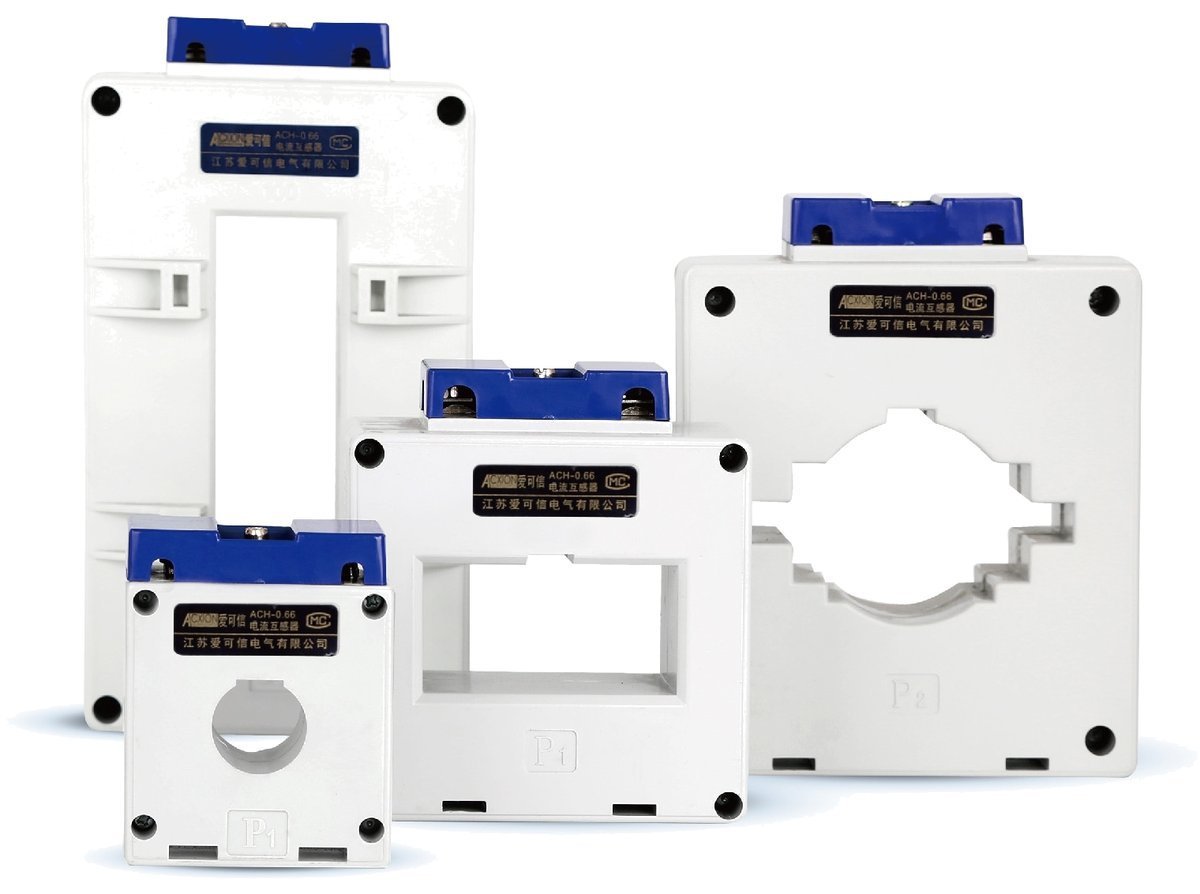
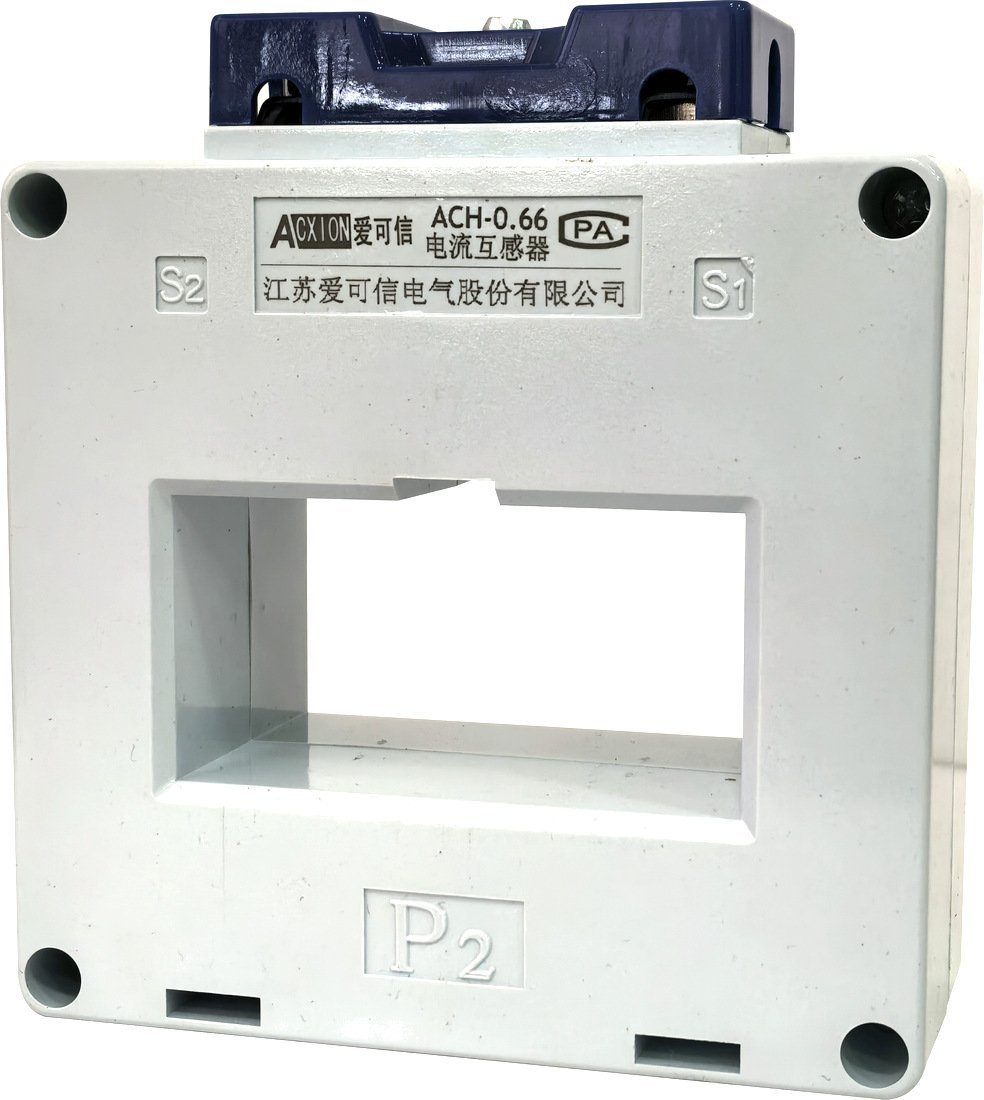
The ACH range divides by what the primary conductor looks like, because the window decides everything else. Type I housings suit cable and compact busbar, in six window sizes from 30I up to 100I, the largest taking cable to roughly 61 mm outside diameter or busbar of 100 by 10 mm. Type II carries rectangular windows for flat busbar, from 33 mm to 155 mm wide depending on housing. Type III is the tall window version for large busbar, covering 500 to 5000 A primary with clamp plate mounting.
Secondary comes as 1 A or 5 A, and the choice mostly follows distance. Long runs between CT and instrument lose less and burden the core less at 1 A. In a compact panel with the instrument beside the CT, 5 A is the usual and cheaper answer.
Accuracy class and burden get chosen together, and this is where orders go wrong most often. The range offers classes 1, 0.5, 0.2, 0.5S and 0.2S, with availability depending on ratio and burden. The burden itself cannot be rounded to a convenient number. It is the instrument’s input burden plus the resistance of the whole secondary loop including cable, and once the real burden exceeds the rated one, the class is simply not met. Ratio and burden tables for every housing sit in the catalogue on the página de descargas, and if the arithmetic gets murky, the página de contacto reaches the people who run it daily.
Common ratings across the series, for reference. Rated voltage is AC 0.66 kV with a maximum of 0.69 kV, at 50 to 60 Hz, ambient minus 30 to plus 70 degrees Celsius. Power frequency withstand is 3000 V for one minute at 50 Hz. Insulation is Class E, installation is up to 3000 metres altitude in a non corrosive, non condensing location. Standard: GB/T 20840.2-2014, aligned with IEC 61869-2.
Retrofit work, where the temptation peaks
Split core exists for the jobs where the primary cannot be opened. Supply that cannot be interrupted. Busbar that cannot come apart. A shutdown window measured in hours. The K series clamps around the conductor and covers busbar widths from the 30 by 10 mm class upward.

What split core does not change is the secondary rule. The secondary is still a winding, and opening it under load produces the same few hundred volts as anywhere else. On retrofit jobs we have seen installers assume that a clamp on CT means the wiring can be tidied later. It cannot. Terminate the secondary first. Close it through the instrument or a link. Then energise.
One word on mounting kits, because they cost people deliveries. Bracket and clamp plate sets are assigned by housing size, and the D short and D long versions are not interchangeable. Three orders last year arrived on site with a kit that matched the housing family but not the size actually ordered, which cost each site a second delivery wait.
A closing note on suspicion
Nothing here replaces your site’s isolation and permit procedures, and work on an energised secondary should be done shorted, with the facility provided, by someone permitted to do it. Suspect a CT has run open? Its accuracy is unknown until somebody proves otherwise. If it feeds protection, take that question to the protection engineer. The meter does not carry the burden of proof. All ratings quoted above come from the current catalogue; the approved ratio and burden table and the drawing shipped with the order remain the final word.
The technician with the taped back leads was not careless by any reasonable standard. He was busy, the job was small, and the danger left no trace until later. That is what makes this particular rule worth repeating: the open secondary gives almost no warning while it is happening, and it happens during other people’s work, not during its own.