








When you are layout out a panel to control a 15HP+ induction motor, heavy industrial heating elements, or 240V solenoid valves, standard control switches just won’t cut it. Signaling a 5V micro-controller relay is easy. Safely routing 20A to 60A high-current inductive loads day in and day out is a whole different ball game.
Every time you switch off an inductive load, you get a massive electromagnetic kickback. This creates a high-energy electrical arc across the contacts that can easily spike over 3000°C. If your switches aren’t built to take that heat, you’re looking at pitted contacts, welded contact blocks, and unexpected downtime. Upgrading to heavy-duty rotary cam switches is the simplest way to keep your panels running and avoid those expensive 3 AM emergency maintenance calls.
The Engineering Behind Heavy-Duty Cam Switches
The number one killer of any rotary switch is contact erosion from electrical arcing. To stop this, ACXION uses heavy-duty, arc-resistant silver alloy (specifically AgNi or AgCdO) contacts. These materials keep electrical resistance incredibly low—typically under 20mΩ—even after a million mechanical cycles. That means no localized hot spots that lead to welded contacts.
Also, you can’t rely on operators to turn a switch quickly enough to stop an arc. That is why these industrial cam switches use a mechanical snap-action spring. When you turn the handle, internal springs build up tension and snap the contacts open or shut in less than 8 milliseconds. It doesn’t matter how slowly someone twists the knob; the internal mechanism disconnects instantly, keeping arc wear to an absolute minimum.
Then there is vibration. If your panels are mounted near rock crushers, textile mills, or marine engines running 24/7, continuous shaking will make cheap toggle switches drift right out of position. ACXION Cam Switches use heavy, spring-loaded steel balls inside the detent mechanism to lock the switch into 30°, 45°, 60°, or 90° positions. It takes a solid, intentional turn (at least 0.5 Nm of torque) to change settings. It won’t vibrate loose, period.
Real-World Problem Solving: Preventing Accidental Machine Starts
Here is a quick look at how this actually works on a real plant floor.
- The Challenge: A food packaging plant in Ohio was having safety near-misses on its 480V conveyor line. When boxes jammed, technicians had to step onto the belt to clear them. But since the line was controlled remotely by a central Allen-Bradley PLC, control room operators would sometimes run system tests or trigger a remote start, completely unaware that someone was standing on the conveyor.
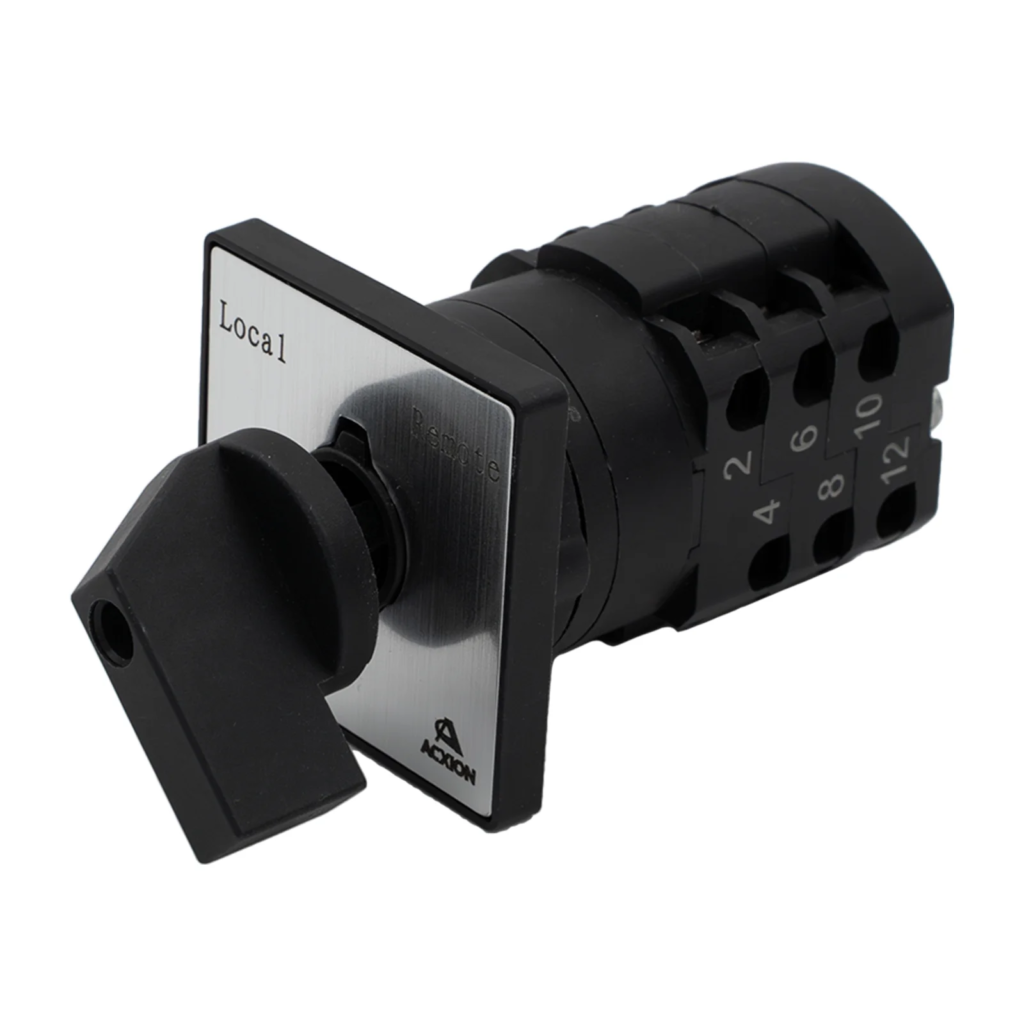
- The Solution: The plant’s electrical team installed an ACXION 5 Terminal General Type Cam Switch right on the NEMA enclosure of each conveyor section, wiring it as a hardwired “Local/Remote” selector.
- The Result: Now, before stepping onto the belt, the technician twists the switch to “Local.” This physically breaks the 24V DC remote PLC control loop and switches power over to the local maintenance circuit. Even if the PLC glitches or someone in the control room clicks “Run All,” the conveyor physically cannot start. The technician has complete control until they walk back and manually turn it back to “Remote.”
Making the Move to Safer Control Panels
A switch is more than just a $15 part on your panel door—it is the one thing standing between your operators and heavy, dangerous machinery. Saving a few cents on cheap selector switches always backfires in the form of melted copper, ruined production runs, and shop-floor accidents. Investing in rugged cam switches with silver-alloy contacts and solid mechanical detents is just smart engineering.
Need to review the specs for your next layout? [Contact the ACXION engineering team today] to grab a catalog, check bulk pricing, or get help mapping out the right contact logic for your project.