



Most enclosure enquiries arrive as one line. “I need a box for three buttons.” The answer takes four decisions, and getting any one of them wrong comes back as a rework ticket rather than a failed part. This guide walks through those decisions using the AH series, the control station family we build at our plant in Jiangyin.
Scope note: everything below covers panel-mounted pushbutton and inspection enclosures for 22 mm and 25 mm operators, up to seven positions, IP65 as standard. Floor-standing cabinets, explosion-proof stations and stainless washdown boxes are different products with different rules. ACXION manufactures this range, so treat the selection advice as coming from the supplier side of the table, not as an independent review.
Decide the operator list before the box
The box is the easy part. The operator list decides everything else. Write down what goes in it, and put a mark next to each item that is not a standard 22 mm push button: selector switches with a long handle, key-operated switches, a 40 mm mushroom head, an indicator light, an ammeter.
Three things in that list change the enclosure.
- A 40 mm mushroom head needs operating clearance around it that a flat compact box does not give you.
- A key-operated switch adds body depth behind the lid, which matters in the shallow families.
- An indicator light adds nothing behind the lid, but it changes the front layout so the operator spacing stops being uniform.
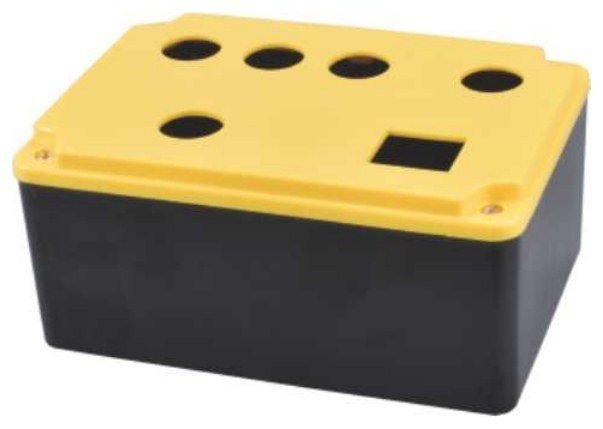
The AH series covers the common cases with seven families. Pick the family from how the box is used, then pick the position count.
| Family | Positions | Cut-out | Cable entry | Where it fits |
|---|---|---|---|---|
| AH2 | 1 to 3 | 22 mm | none | Small local station, one or two functions |
| AH3 | 1 to 6 | 22 mm | none | Narrow columns, multi-position rows |
| AH4 | 1 to 3 | 22 mm | internal DIN rail | Terminal or relay component inside |
| AH5 | 1 to 6 | 22 or 25 mm | none, or gland with suffix P | General purpose, the widest range |
| AH7 | 1 to 7 | 22 mm | gland (P) | Yellow service box for maintenance work |
| AH8 | 1 to 6 | 22 mm | strain-relief (F) | Cable that is moved or flexed |
| AH11 | 2 or 6 | mixed layouts | gland, raised cover | Larger operator groups |
Housing size follows the position count. As a reference, the AH11 family runs from about 120 x 100 x 70 mm for the two-position version with a gland, through 160 x 130 x 82.5 mm for six positions, up to 246 x 170 x 97 mm for the six-position version with a raised cover.
Read the model code one field at a time
A full code looks like this: ACX-AH5-3-22-WK-P. Five fields, and the last two are the ones buyers skip.
- Series. AH2, AH3, AH4, AH5, AH7, AH8 or AH11.
- Positions. One to seven, depending on the series.
- Cut-out. 22 for Ø22 mm operators, 25 for Ø25 mm.
- Housing colour. Two letters, cover first, base second. WK is a white cover on a black base, YK is yellow on black, KW is black on white, WW is white on white.
- Cable entry. Blank for no fitting, P for a factory-fitted cable gland, F for a strain-relief gland.
- Option. Blank, or H for the raised-cover version.
Two points on colour. Yellow covers are the conventional choice for maintenance and service stations because they read as “not part of the normal process”. IEC 60073 sets out the colour coding principles for indicators and actuators on panels, and a yellow enclosure fits the spirit of that without being required by it. Second, colour is a cover and base combination, not a single paint code, so swapping to a different look means confirming both letters.
Three details that cause most of the rework
Gland thread against actual cable diameter
Our own catalogue carries the warning, and it earns its place. The factory-fitted glands in the AH5-P and AH7 families cover a range of cable diameters, and the range is printed in the quotation for a reason.
On a maintenance station order for an Indonesian site last year, the incoming cable was 13 mm outside diameter with a heavy outer sheath. The standard gland accepted the cable, but only after the sheath was trimmed back inside the box. Trimming inside an IP65 enclosure is not a design feature. Send the cable type and outside diameter with the enquiry and the gland gets matched at the factory.
Operating clearance around a mushroom head
A 40 mm mushroom head sitting between two 22 mm operators is tight. In an AH2 with three positions, the gap left for a gloved hand drops below what most operators find comfortable, and the mushroom head also sits close to the lid edge. We stopped quoting that layout as a standard build after two units from the same customer came back with the same complaint about the gap. The alternatives are an AH11 with a raised cover, where the head sits above the lid plane, or two separate boxes with the emergency stop on its own.
If you need an emergency stop station as a complete unit rather than a box plus a head, the AH range also includes the JDPJ-JT emergency-stop box and the JDPJ-FM combined audible and visual alarm box.
Spare positions and the IP claim
IP65 means protection against dust ingress and water jets from any direction, as defined in IEC 60529. That rating applies to the assembled box with every position either filled or plugged. An AH5-6 shipped with two operators and four open cut-outs is not an IP65 enclosure, it is a box with four holes.

This matters outdoors and in washdown areas. On an outdoor column in a monsoon climate, a spare position left open lets water track onto the terminal block inside. Order a plug for every unused position, or order the position count you actually need. Ordering a six-position box “in case we add something later” is the most common way to void the rating.
Inspection and local control products
The AH catalogue also carries the products that go around a control station rather than in it. Flush-mounted and wall-mounted inspection lights (JDZM-MB and JDZM-BG) light the working area during maintenance. The JDJX-5H is a five-position hand-held inspection station rated IP65, which suits the walk-around check on a line where the panel is not where the operator stands. These are not the parts most enquiries start with, but they are usually the parts that arrive late.
Ordering checklist
Send these nine items and the quotation comes back correct the first time.
- Number of operators, and the type of each one
- Ø22 mm or Ø25 mm cut-outs
- Cover and base colour
- Cable entry: none, gland (P), strain-relief (F)
- Flat or raised cover (H)
- Cable type and outside diameter
- Whether any position stays spare, and how it will be plugged
- Marking or nameplate text, if the panel needs it
- Quantity and destination
The full range with dimensions and family tables is in the AH series selection catalogue on our download centre. Standard operators, contact blocks and heads sit in the push button heads category, and the NO contact modules that most of these boxes use are here: NO normally open contact module. For emergency stop heads, the mushroom and emergency stop button category covers the pull-release and twist-release versions.
Not every code combination in the catalogue is a stocked item. Non-standard colours, unusual cut-outs and raised-cover combinations are confirmed before release, and the drawing supplied with the order is the final authority on dimensions. Enclosures in this range are built to order from the catalogue, and each configuration is quoted separately. Send the layout and we will work it up.