



Last month a parcel came back to the workshop from a bottling plant. Inside was a contact block from a 22 mm push button, and the normally closed face had a grey-white blob maybe two millimetres across where the silver had melted and frozen again. The rest of the face still looked new. The customer’s note said the button had switched a 24 V DC brake solenoid “about four hundred times a day, no problems for a year, then it welded shut during a shift change.”
Four hundred operations a day at 24 V. On paper that is nothing. The datasheet for the part says 10 A, and the solenoid drew under one. Yet the contact welded, and the reason is written on the same datasheet in two letters and three digits that most people read straight past.
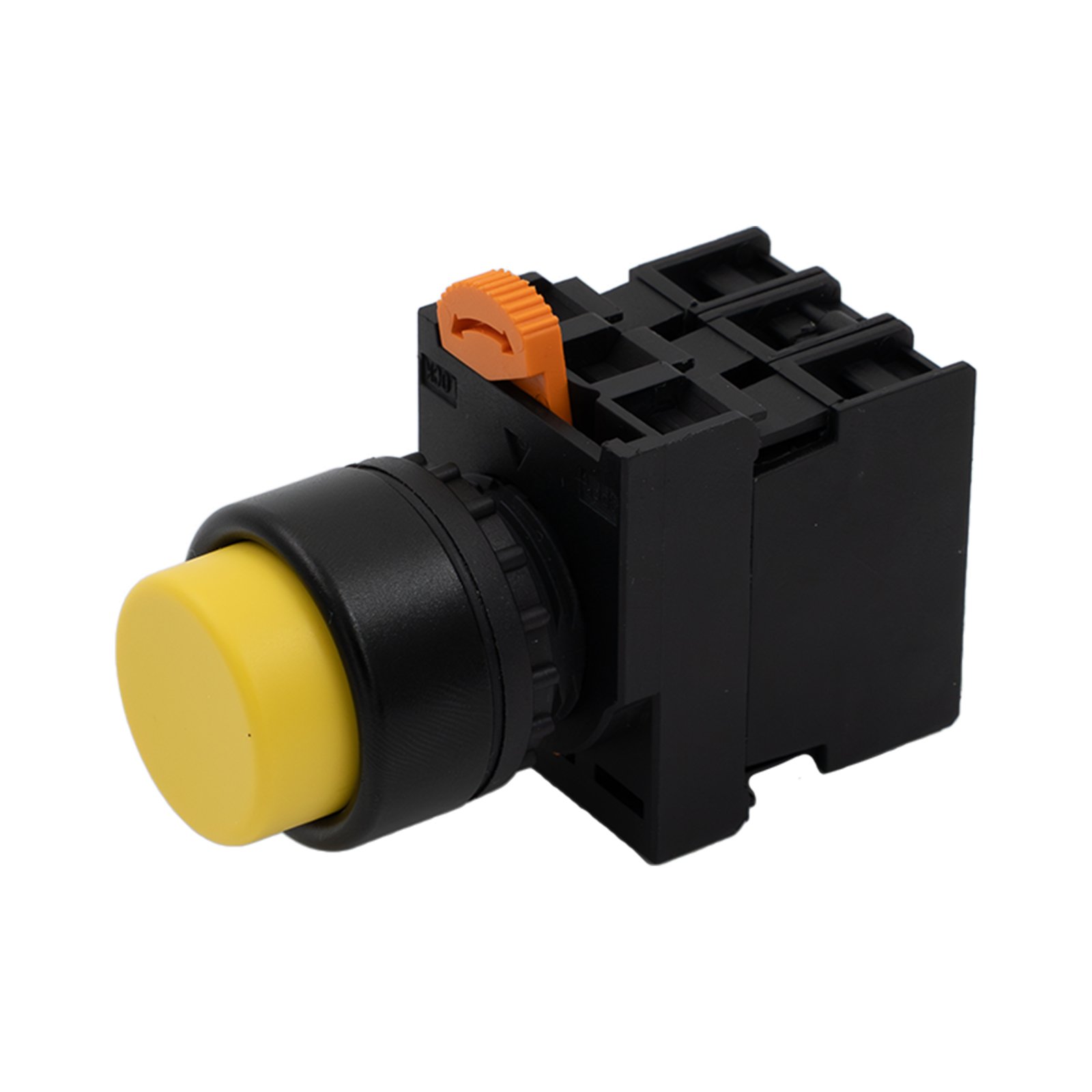
This piece is about contact blocks on 22 mm industrial push buttons and selector switches that follow IEC 60947-5-1, the ones switching control circuits rather than feeding motors. Sizing a contactor or a starter is a different part of the standard, with its own method. Do not carry these numbers over. Disclosure, because it changes how you should read the rest: we build the XH2 and LA135 ranges used as examples below. What follows is a manufacturer explaining its own datasheets. Not a lab report.
Two figures that get quoted for the wrong job
Open any catalogue page and the two boldest electrical numbers are usually rated insulation voltage and conventional thermal current. On our XH2 platform those read Ui 600 V and Ith 10 A. Laid side by side they invite a reading the datasheet never intended, something like “10 A at up to 600 V.” Neither number describes the act of opening a contact, which is the whole job of a switch.
Ith is a heat figure. It tells you what the contact can carry continuously while closed, sitting in free air, without the terminals climbing past their permitted temperature rise. It drives how much copper goes into the terminal screw and how stiff the contact spring needs to be. Closing, carrying, nothing more.
Ui belongs to the insulation system. It is the voltage the insulation was type tested against, and next to it on the same line sits Uimp, the impulse withstand of 6 kV. Both describe the environment the device can live in safely. Neither says anything about putting out an arc.
Where the real rating hides
The switching capability is buried in the utilization category. On our 22 mm platform it reads AC-15 and DC-13, with A600 and Q600 alongside. Four short codes. Each one hides a test regime: make current, break current, power factor, number of operations.
AC-15 is the alternating current category for electromagnetic loads. Coils on contactors, solenoids on valves, the odd clutch winding. Anything with a magnetic field that collapses when you cut it. Inductive load. When the contacts part, the field collapses and pushes current across the gap as if the circuit were still closed. The standard’s test conditions ask for a make current several times the steady state value, because a coil draws far more while its armature is still travelling, and the power factor is kept well below unity to make the break genuinely difficult.
DC-13 covers the same job on direct current, and it is the smaller number on paper while being the harder one in practice. That has nothing to do with power level, which is exactly what caught out the contact block in the opening story.
A600 and Q600 exist because UL and IEC grew up as separate conventions. A machine bound for both markets needs both lines on the part. If a datasheet shows just one set, ask the supplier which standard the other figure is meant to satisfy. Vague answers are information too.
Why direct current is the awkward case
Fifty hertz gives you a hundred zero crossings a second. Sixty hertz gives you a hundred and twenty. That is the whole trick behind AC arc control. At each one the arc goes hungry for an instant. If the gap has widened enough by then, it never comes back. Practically all arc control in an AC device leans on that moment existing.
Direct current never gives you that moment. The arc between separating contacts has to be killed the hard way, by stretching it, cooling it, and letting the gap voltage climb past what the supply can hold. While it burns, metal migrates from one face to the other. There is no natural end to the process except the gap getting wide enough, and on a small contact block that happens at a modest distance.
So when the DC-13 rating sits far below Ith, that is not the manufacturer being timid. On DC the waveform simply offers less help, and the numbers reflect the physics rather than the marketing.
Two ways a contact dies
When a block reaches us as a warranty return, the first thing we read is not the contact. It is the line on the return form describing what the block was switching, because the answer is usually there before the multimeter comes out.
The physical evidence agrees. Repeated breaking of a DC solenoid leaves localised fusion on a small patch of silver while the plating around it still shines. An arc sat in one spot and did all its work there. Carrying too much current looks different: the whole face discolours, and sometimes the contact spring has lost its temper, because the heat came from resistance across a closed contact rather than from an arc.
Two failure modes, two different cures, and only one of them is “buy a bigger device.” The welded brake contact needed either a DC-13 figure checked against the solenoid’s inrush, or a relay between the button and the load. Neither option costs much. Both were cheaper than the stopped line.
What to check before the order goes in
Start from the load itself. A button driving a PLC input or a small relay coil lives an easy life, and the arithmetic is quick. A button switching a contactor coil directly takes that coil’s inrush on every press. A button breaking a DC solenoid deserves the awkward case: compare the coil’s holding current against the DC-13 figure instead of trusting instinct.
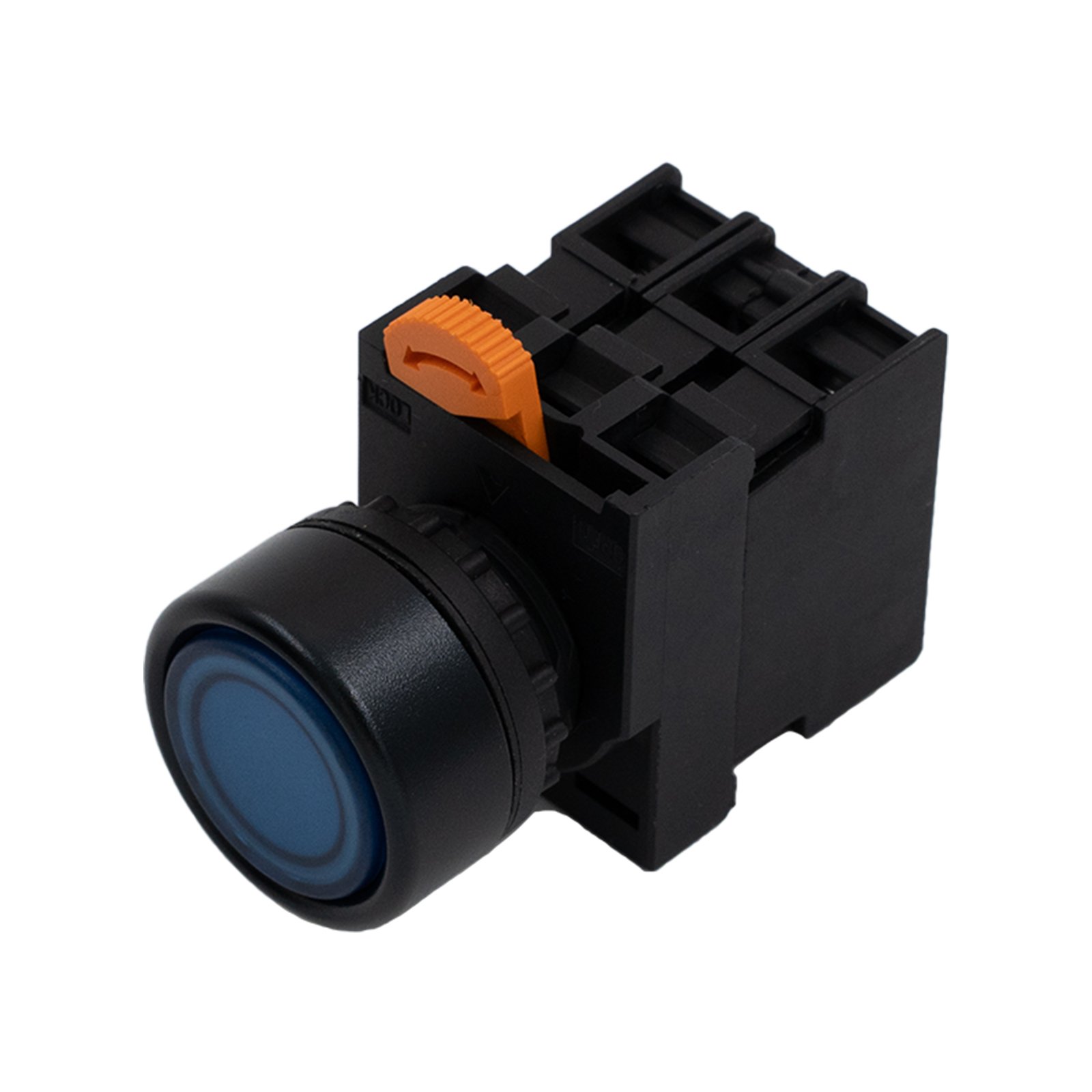
Then confirm which family you are actually ordering from, because ratings move between them. Within our кнопочные переключатели range, the compact LA135 platforms carry Ui 250 V and Ith 5 A on the 16 mm body, with 1,500 V RMS power frequency withstand for one minute, while the 22 mm bodies carry 400 V and 10 A with 2,500 V. Same family name on the catalogue spine, materially different capability. A smaller device substituted to save panel width is not a like for like swap.
Mechanical life belongs in the same check. The momentary XH2 versions are rated for three million operations, the latching, mushroom and selector versions for 100,000, and electrical life across the range is at least 100,000 cycles. A start button that is mostly pressed wears mechanically. A button breaking an inductive load wears electrically, and the second number is the one that matters there.
Illuminated units add one more line. On something like our 1NO1NC illuminated raised head push button, the LED block runs as its own low level circuit at no more than 15 mA, so lamp duty and contact duty get decided independently. The contact block has to survive the coil. The lamp only has to be visible. Rating tables for both families are in the catalogues on the страница загрузок. Run the same check against your own panel before you order.
The 10 A on the front of the part still means what it meant on day one. Carry it all day, every day, and it will not complain once. Breaking 10 A is a separate question. The answer is in two letters and three digits, and it is never the boldest number on the page.