








Anyone who has spent hours wiring industrial control cabinets knows the frustration of mismatched hardware. You drill the holes, mount the components, and pray the tolerances line up. When a machine goes down on a live factory floor, maintenance crews don’t have the luxury of modifying enclosure cutouts—they need a direct, drop-in replacement immediately.
This operational reality is why strict dimensional standardization isn’t optional; it’s a survival metric for panel builders. While operator interfaces come in various shapes and configurations, the 22mm push button switch remains the undisputed backbone of industrial automation.
The 22mm Standard: Balances Footprint and Durability
Walk through any modern manufacturing facility, and 22mm (roughly 7/8 inch) mounting holes appear on almost every control console. This uniformity is driven by practical physics. A 22mm cutout hits the exact sweet spot between back-of-panel spacing and rugged mechanical reliability.
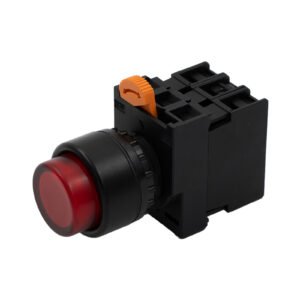
Mechanically, a 22mm opening provides enough physical volume to house heavy-duty return springs, robust contact blocks, and bright LED illumination modules. Yet, it is compact enough to allow engineers to cluster critical start, stop, and emergency functions closely together on an HMI face without overcrowding the layout. More importantly, from an operator’s perspective, a 22mm actuator head provides a large enough target to be reliably struck by a worker wearing thick, insulated safety gloves.
To meet these demanding shop-floor environments, lines like the ACXION Electric 22mm series focus heavily on material limits rather than just dimensional compliance. Industrial controls require diversity within that single 22mm footprint:
- Emergency Stops: Self-locking mushroom heads designed for blind, fail-safe slap activation.
- Momentary & Latching Buttons: Flush or extended profiles tailored to prevent accidental actuation.
- Integrated Illumination: Low-draw, high-visibility LEDs capable of cutting through poor plant lighting.
- Selector Configurations: Multi-position rotary switches sharing the exact same panel-cutout footprint.
When these components utilize zinc-alloy or heavy-grade PA66 nylon bezels paired with proper sealing gaskets, they achieve IP65 or higher ratings. This keeps dust, cutting fluids, and high-pressure washdowns away from sensitive internal contact points.
Scaling Up or Down: 16mm and 30mm Realities
Though 22mm rules heavy industry, specific machine topologies occasionally force engineers away from the standard standard. Panel design typically forces a choice between two alternative footprints:
16mm Controls: Minimizing the Footprint
As field equipment shrinks and medical devices or compact telecom enclosures require localized control, panel space disappears. The 16mm standard trades massive contact blocks for minimal back-of-panel depth. These compact switches allow for high-density control arrays where internal wiring space is severely restricted, without sacrificing the positive tactile feedback operators expect.
30mm Controls: Managing Legacy Infrastructure
Older North American machinery and massive power distribution switchgear frequently rely on 30mm cutouts. While new designs have largely shifted to 22mm, maintaining a robust 30mm supply chain remains vital for MRO (Maintenance, Repair, and Overhaul) teams. Heavy-duty 30mm operators are essential when a system requires massive, high-capacity contact arrangements or oversized operators built for extreme abuse.
Streamlining the Assembly Line
Standard sizing only solves half the problem; the actual layout efficiency dictates long-term panel profitability. Real-world bottlenecks usually happen behind the panel during installation and maintenance.
Eliminating these bottlenecks requires smart hardware engineering, such as the tool-free, snap-on contact blocks found in the ACXION lineup. Allowing a technician to swap a damaged contact block without unmounting the entire switch body from the enclosure face dramatically slashes downtime.
Visual consistency across the panel face matters just as much as mechanical speed. When pilot lights, selector switches, and standard push buttons share identical bezel finishes and material profiles—whether layout specs demand a 16mm matrix or a heavy-duty 22mm line—the finished enclosure looks precise, professional, and built to uniform standards.
Securing the Bill of Materials
Specifying components that stick to tight global dimensions isn’t a matter of convenience—it ensures long-term field serviceability. Whether a BOM specifies a high-visibility 22mm E-stop, a space-saving 16mm momentary node, or a legacy 30mm rotary switch, choosing hardware backed by rigorous dimensional engineering keeps your infrastructure running without field modifications.