








Dans le domaine du contrôle industriel, les boutons-poussoirs standard permettent de gérer le fonctionnement quotidien des machines, mais les boutons d'arrêt d'urgence (E-stops) ont une fonction tout à fait différente. Lorsqu'un problème survient sur une chaîne de convoyage, une presse à estamper ou un système d'emballage, l'opérateur ne regarde pas le tableau de commande ; il appuie immédiatement sur le bouton en forme de champignon rouge vif le plus proche.
Pour les fabricants de tableaux électriques, les équipementiers et les distributeurs industriels, choisir le bon arrêt d'urgence ne se résume pas à sélectionner une découpe de 22 mm et à en rester là. Il s'agit de respecter des normes de sécurité internationales strictes, de garantir la fiabilité des contacts mécaniques et de choisir le mécanisme de réarmement adapté à l'environnement de travail spécifique.
Voici un aperçu concret du fonctionnement des interrupteurs d'arrêt d'urgence, des caractéristiques de conformité à prendre en compte et des éléments à garder à l'esprit lors de leur approvisionnement pour les marchés internationaux.
Le principe mécanique : pourquoi les boutons-poussoirs standard ne peuvent pas servir d'arrêts d'urgence
Une idée fausse courante chez les acheteurs débutants consiste à penser qu'un arrêt d'urgence n'est rien d'autre qu'un simple bouton-poussoir momentané muni d'un capuchon rouge plus grand. En réalité, les normes de sécurité (telles que les normes CEI 60947-5-5 et ISO 13850) l'interdisent formellement.
Un bouton-poussoir standard utilise des ressorts de rappel internes pour séparer les contacts électriques lorsqu'on le relâche. Si un courant d'appel élevé provoque le soudage de ces contacts, le fait d'appuyer sur le bouton ne permettra pas de couper le circuit.
Les arrêts d'urgence, en revanche, nécessitent un Action d'ouverture directe (souvent appelée « action d'ouverture positive »). À l'intérieur d'un bloc de contacts d'arrêt d'urgence conforme, le mouvement mécanique consistant à appuyer sur la tête en forme de champignon écarte les contacts NC (normalement fermés) directement par le biais de liaisons mécaniques rigides, et non à l'aide d'un ressort. Même si les surfaces de contact se sont légèrement soudées en raison d’un pic de surintensité, la force physique exercée par la paume de l’opérateur rompt cette soudure et interrompt le circuit électrique.
Choisir le bon mécanisme de réinitialisation : rotatif ou à tirer pour réinitialiser
Lorsqu'un arrêt d'urgence est déclenché, les règles de sécurité exigent que l'interrupteur se verrouille en position d'ouverture. La remise sous tension nécessite une intervention humaine délibérée, et le choix entre les différents mécanismes de réinitialisation dépend généralement du mode de fonctionnement de la machine dans l'atelier.
- Réinitialisation par rotation (twist-to-release) : Le choix classique pour les tableaux de commande généraux, tels que ceux d’ACXION Bouton-poussoir d'arrêt d'urgence à tête champignon 1NC à réarmement rotatif. Les opérateurs tournent la tête en forme de champignon dans le sens des aiguilles d'une montre pour déverrouiller le dispositif après avoir corrigé une erreur. Ce système est rapide, intuitif et fonctionne bien dans les environnements industriels intérieurs propres.
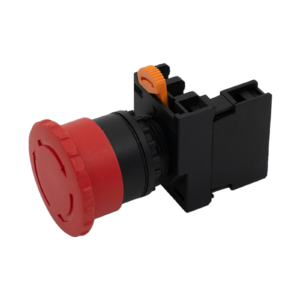
- Réinitialisation par traction : Idéal pour les machines soumises à de fortes vibrations ou les environnements dans lesquels les opérateurs risquent de heurter accidentellement un panneau, comme ceux d'ACXION Interrupteur à bouton-poussoir d'arrêt d'urgence à tête en forme de champignon 1NC à réarmement par traction. Le fait de devoir tirer fermement et directement pour déverrouiller empêche les réinitialisations accidentelles pendant les quarts de travail intenses.
Intégration de panneaux en conditions réelles : l'étude de cas ACXION
Le choix d'un mécanisme d'arrêt d'urgence adapté fait toute la différence en termes de fiabilité sur le terrain, en particulier sur les chantiers aux conditions difficiles.
Nous avons récemment collaboré avec un équipementier d’Amérique du Sud spécialisé dans la fabrication d’équipements agricoles lourds. Leurs chaînes de convoyage en extérieur étaient soumises à de fortes vibrations et à de fréquents lavages dus à la poussière. L’entreprise utilisait jusqu’alors des arrêts d’urgence génériques à déverrouillage par rotation, mais les opérateurs, qui portaient des gants de travail épais, avaient beaucoup de mal à tourner les petits capuchons en forme de champignon après avoir débloqué des bourrages. Pire encore, la poussière fine obstruait le loquet rotatif interne, provoquant le grippage des interrupteurs.
Après avoir évalué leur installation, nous les avons aidés à moderniser leurs panneaux à l'aide de ACXION’de sa gamme modulaire d'arrêts d'urgence. Pour leurs postes d'opérateur principaux, ils ont opté pour l'ACXION Interrupteur d'arrêt d'urgence à tête champignon, 1NC, à réinitialisation par traction. Le mouvement de réinitialisation par traction en ligne droite permettait aux opérateurs portant des gants de rétablir l'alimentation sans effort, sans avoir à lutter contre la friction causée par la poussière à l'intérieur d'un mécanisme à vis.
Pour leurs postes de contrôle secondaires en intérieur, ils ont déployé l'ACXION Interrupteur d'arrêt d'urgence à tête champignon à réinitialisation rotative 1NC. Les deux modèles étaient équipés de joints d'étanchéité IP65 à haute résistance et de contacts NC en alliage d'argent à action d'ouverture directe.
En adoptant le système 22 mm d’ACXION, le client a réussi dès la première tentative les audits locaux de sécurité des machines, a éliminé les blocages des interrupteurs dus à la poussière et a réduit le nombre d’interventions de maintenance sur les tableaux électriques de l’ensemble de ses installations sur site.
Conseils pratiques pour l'approvisionnement en dispositifs d'arrêt d'urgence
- Vérifiez la présence du symbole “ Ouverture positive ” : Recherchez sur le boîtier du bloc de contact ou dans la fiche technique le symbole indiquant l'action d'ouverture directe (une petite flèche à l'intérieur d'un cercle : $\rightarrow$). Si ce marquage est absent, l'interrupteur n'est pas certifié pour les boucles de sécurité d'urgence.
- Adapter l'indice de protection IP à l'application : Pour les chaînes de montage en intérieur, l'indice IP65 est suffisant. Pour les zones soumises à des lavages à haute pression ou les équipements destinés à une utilisation en extérieur, veillez à ce que les joints en caoutchouc haute résistance soient correctement positionnés autour du piston de commande et du trou de fixation du panneau.
- Réfléchissez bien au choix des housses de protection : Les capots de protection jaunes permettent d'éviter les chocs accidentels dans les allées étroites des usines. Veillez toutefois à ce que la conception du capot permette toujours à la paume d'une main gantée d'atteindre facilement la tête en forme de champignon sous n'importe quel angle, conformément à la norme ISO 13850.