








In the world of industrial control, standard push buttons handle day-to-day machine operations, but emergency stop switches (E-stops) carry a very different responsibility. When something goes wrong on a conveyor line, stamping press, or packaging system, an operator doesn’t look at the panel; they slap the nearest bright red mushroom head.
For panel builders, machinery OEMs, and industrial distributors, specifying the right E-stop isn’t just about picking a 22mm cutout and calling it a day. It comes down to strict global safety standards, mechanical contact reliability, and choosing the right reset mechanism for the specific working environment.
Here is a practical look at how E-stop switches actually work, the compliance features that matter, and what to keep in mind when sourcing them for international markets.
The Mechanical Logic: Why Standard Push Buttons Can’t Be E-Stops
A common misconception among junior buyers is assuming an emergency stop is just a regular momentary push button fitted with a larger red cap. In reality, safety standards (such as IEC 60947-5-5 and ISO 13850) strictly forbid this.
A standard push button relies on internal return springs to separate electrical contacts when released. If high inrush current causes those contacts to weld together, pressing the button won’t break the circuit.
E-stops, on the other hand, require a Direct Opening Action (often called positive opening action). Inside a compliant E-stop contact block, the mechanical movement of pressing the mushroom head forces the NC (Normally Closed) contacts apart directly through rigid mechanical linkages—not by relying on a spring. Even if the contact surfaces have slightly welded due to an overcurrent spike, the physical force of the operator’s palm breaks the weld and interrupts the power path.
Choosing the Right Reset Mechanism: Rotary vs. Pull-to-Reset
Once an E-stop is hit, safety regulations require the switch to lock in the open-circuit position. Restoring power requires deliberate human action, and selecting between different reset mechanisms usually depends on how the machinery is operated on the shop floor.
- Rotary Reset (Twist-to-Release): The standard choice for general control panels, such as ACXION’s 1NC поворотный сброс гриб головы аварийной остановки кнопка переключатель. Operators turn the mushroom head clockwise to release the lock after resolving an error. It’s quick, intuitive, and works well in clean indoor industrial environments.
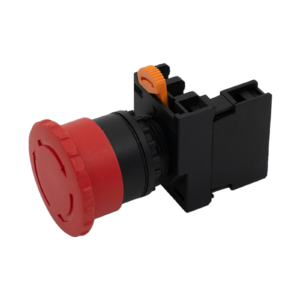
- Pull-to-Reset: Ideal for high-vibration machines or environments where workers might accidentally brush past a panel, such as ACXION’s Кнопочный переключатель аварийного останова с грибовидной головкой 1NC Pull-to-Reset. Requiring a direct firm pull to unlock prevents accidental resets during frantic production shifts.
Real-World Panel Integration: The ACXION Case Study
Selecting the right E-stop mechanism makes a huge difference in field reliability, especially on harsh job sites.
We recently worked with a machinery OEM in South America building heavy-duty agricultural processing equipment. Their outdoor conveyor lines suffered heavy vibration and frequent dust washdowns. They had been using generic twist-release E-stops, but operators wearing thick work gloves kept struggling to twist the small mushroom caps after clearing jam-ups. Worse, fine dust was clogging the internal rotary latch, causing switches to stick.
After evaluating their setup, we helped them upgrade their panels using ACXION’s modular E-stop line. For their main operator stations, they switched to the ACXION 1NC Pull-to-Reset Mushroom Head Emergency Stop Switch. The straight pull-to-reset motion allowed glove-wearing operators to restore power effortlessly without fighting dust friction inside a twist mechanism.
For their secondary indoor control desks, they deployed the ACXION 1NC Rotary Reset Mushroom Head Emergency Stop Switch. Both models featured heavy-duty IP65 seals and silver-alloy NC contacts with direct opening action.
By standardizing on ACXION’s 22mm system, the client passed local machinery safety audits on the first try, eliminated dust-related switch jams, and reduced panel maintenance calls across their field installations.
Practical Sourcing Notes for E-Stop Procurement
- Verify the “Positive Opening” Symbol: Look at the contact block casing or datasheet for the direct opening action symbol (a small arrow inside a circle: $\rightarrow$). If this marking is missing, the switch is not certified for emergency safety loops.
- Match Ingress Protection to the Application: For indoor assembly lines, IP65 is fine. For washdown zones or outdoor gear, ensure heavy-duty rubber seals sit properly around the operating plunger and panel mounting hole.
- Consider Protective Shrouds Carefully: Yellow protective shrouds prevent accidental bumps in narrow factory aisles. However, make sure the shroud design still allows a gloved palm to hit the mushroom head easily from any angle, as mandated by ISO 13850.