



An indicator light looks like the simplest part on the panel, and it is the one that gets ordered wrong most often. Not because the price is confusing, but because the code carries five fields that all look similar, and the supply type sits in the middle of them. Here is how we read an AD115 code, using the range we build.
Scope note: this covers panel-mounted LED indicator lights in 16 mm, 22 mm and 25 mm mounting sizes, including bi-colour, semaphore, position, flash and audible versions. Tower lights and machine-mounted stack lights are a different family. ACXION manufactures the AD115 range, so the advice comes from the supplier side.

The code, field by field
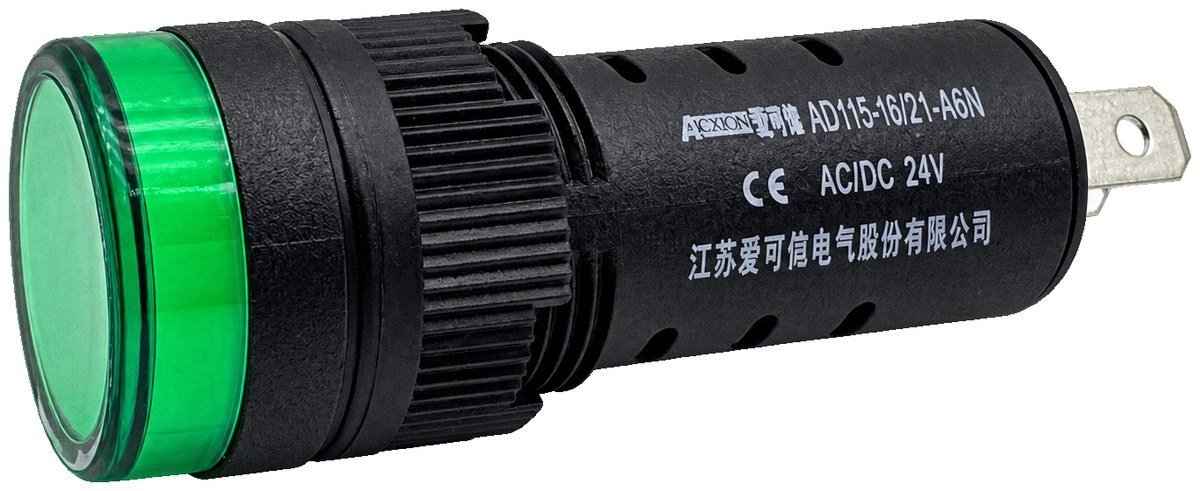
A typical code runs: AD115-22/21-A7-220-RD. Read it left to right and each field answers one question.
| Field | Example | What it decides |
|---|---|---|
| Series | AD115 | The indicator light family |
| Mounting | 22 | 16, 22 or 25 mm panel cut-out |
| Type | 21 | Voltage type: 2 is AC/DC, 4 is AC only |
| Head | A7 | Head shape and optical style |
| Voltage | 220 | Rated operating voltage |
| Colour | RD | Lens colour: RD, GN, YE, BU, WH, BK |
| Option | IP65 | Protection, anti-interference level or salt-spray version |
The field that gets misread is the third one. It sits between the mounting size and the head style, it is two digits, and it decides whether the lamp works on a DC control supply.
The AC/DC trap, and how it shows up
We shipped a batch of 220 V indicators to a substation project where the control supply was 220 V DC from the station battery. The order line said 220 V, and that was all it said. The AC-only version does not light on DC. The site spent a morning checking wiring on two panels before anyone looked at the code.
Since then our order form asks for the supply type as a separate line, not as part of the voltage. The AC/DC version (type 21) covers the full 6 to 380 V AC/DC span on most head styles, and selected AC configurations extend to 415 V and 500 V. Where the panel has both AC and DC circuits, ordering everything as AC/DC removes the whole class of error at a small cost difference.
The same trap exists in reverse on a 24 V DC panel built from AC-only parts left over from another project. The lamps light, dimly, and then fail early, because the internal circuit is running outside its design condition.
Colours and the panel standard
Colours follow the common convention: RD red, GN green, YE yellow, BU blue, WH white, BK black. IEC 60073 sets out the coding principles for indicators and actuators, and the practical rules most panels follow are straightforward. Red for a condition requiring attention, green for normal or running, yellow for an abnormal condition that is not yet a fault, blue for a condition needing operator action.
Two notes on colour selection. First, colour alone is a weak signal for anyone with a colour vision deficiency, so a symbol-based indicator or a labelled nameplate carries information that colour cannot. Second, the position indicator family (WD for disconnector, WN for ground) has fixed symbols instead of colour codes. Those are not interchangeable with the coloured types, and the symbol is set by the model.
Matching the head to the mounting depth
The head shape decides how the lamp looks and how much room it needs behind the panel.
- A6 family for 16 mm cut-outs, including the A6S and A6CS shortened variants where the panel depth is limited.
- A5, A7 and A8 for 22 mm, with A8 giving the larger illuminated cap and A7 the standard face.
- HS for 22 mm with quick-connection terminals, which shortens assembly time on a panel with a lot of lamps.
- A9 in round, conical and square formats, for higher visibility on a large fascia.
- SS for bi-colour, WG for semaphore graphics, M and DM for buzzer and illuminated buzzer versions.
On the electrical side the specification is consistent across the family. LED working life is 30,000 hours or more. Power-frequency withstand is 2,500 V AC RMS for one minute, and insulation resistance is 5 megohm up to 60 V and 50 megohm above that. The range operates from -25 to 50 degrees C and is vibration tested from 10 to 2,000 Hz at 1.5 mm and 10 g. Installation category III, pollution degree 3. Front protection is IP54 as standard, with IP65 available as an option.
That vibration figure is why the range gets specified on press lines and machine tools. A filament lamp would not survive it. Neither does a badly made LED, which is why the vibration condition is worth checking on the data sheet rather than assuming.
Salt spray, and the project where it mattered
A port crane panel in a coastal yard had standard indicators fitted throughout. Within a year the bezels were pitted and two lamps had lost their seals, which let moisture into the body. The replacement order came with a photograph, and the TH salt-spray version went in across the panel.
The alternative to the TH version is a fully sealed IP65 front, which handles washdown and rain but does not change the corrosion behaviour of the exposed metal. In a coastal or chemical environment, both are usually specified together.

Three checks before the order goes out
- DC or AC supply. State it separately from the voltage. Choose the AC/DC type where there is any doubt.
- Environment. Indoor dry panel, washdown area, or coastal and salt-laden air. That decides IP65 and the TH option.
- Mounting size and depth. 16 or 22 mm, and whether the panel is deep enough for the standard body or needs the shortened version.
Add the anti-interference level where the control cable runs a long distance to the panel, since induced voltage on a long run can keep an LED lit at a low glow. That is a wiring problem as much as a lamp problem, and the higher interference level reduces the symptom without removing the cause.
One thing we do not recommend: fitting a 22 mm indicator into a 25 mm hole with a packing ring. The result holds water at the ring and stops being sealed at all. If the panel is drilled at 25 mm, use the 25 mm body.
Ordering
Send the mounting diameter, head style, lens colour, voltage and the supply type, plus any environmental requirement. Those five lines are enough to confirm a code.
The full AD115 selection tables, head styles and dimensional drawings are in the indicator light catalogue on our download centre. Individual parts are listed in the indicator lights category, including the 24 V LED indicator module and the round flat indicator light, AC 220 V.
Voltage levels other than the listed ones can be customised, so a non-standard supply is a question rather than a problem. The range is supplied to the code you specify and quoted per configuration, so a non-standard combination is a quotation request rather than a fixed part number. Ratings come from the current catalogue; the delivery specification and the order confirmation are the final authority.