



A packaging plant called us on a Monday about a filling machine that refused to start, roughly one shift in three. By the time their electrician reached the panel it had started again, which is how these cases usually go. He put a multimeter across the start button contacts, heard the continuity beep, and reported the switch fine. The production manager disagreed. The PLC input LED stayed dark on those same presses, and the machine did not care what the meter thought.
Both instruments were telling the truth. They were just answering different questions, and the argument that follows from this, in one form or another, reaches us several times a month.

The subject is the 22 mm industrial push button contact block feeding low voltage electronic inputs: PLC cards, drive control terminals, counter inputs. Switching at signal level rather than driving a coil. What follows is diagnostic rather than prescriptive, and since ACXION builds these switches, including the gold plated contact variants, it is the supplier’s answer to a question our own customers keep asking.
What the continuity beeper actually does
Continuity mode does not measure the circuit. It measures the circuit plus the meter. Inside the meter there is a source, and it is stronger than anything your PLC input will ever inject. Push that through a thin oxide film and the beeper sings. An oxide film a few molecules thick conducts well enough to satisfy a meter and badly enough to starve a digital input.
The PLC input is the weaker instrument by nature. It sits at 24 V, sometimes 12 or 5 V on high density cards, and draws a few milliamps when read, some modules sampling rather than drawing continuously. There is very little voltage available to punch through surface film, and very little current to warm it away.
So the meter beeps across a contact the input cannot read through. Nobody is lying. Same film, two verdicts. The disagreement is real, not a fault.
Trust the input, not the meter
The cheapest reliable test takes ten seconds and no tools. Have someone press the button. Watch the LED on the card. Leave the meter in the bag. Comes on every time? The switch is fine. Look downstream. Flickers, or misses one press in twenty? That contact is marginal, and no resistance reading taken on a dead panel will change my mind about it.
Next step is voltage, not resistance. Circuit live, meter across the input and its common, then press. Read what the card sees. Half the supply volts where you expected all of them. That number alone usually ends the argument. Still unsure which side is guilty? Hold the button down and short the two conductors at the card. Clean LED means switch or wiring.
The expensive version of this story is the one where somebody tests resistance on an isolated panel, declares the switch sound, and starts replacing input cards. We have watched that purchase order arrive after the real fault had already been fixed with a five minute clean.
The figure almost nobody looks up
Every contact has a lower limit as well as an upper one. Go below a certain current and voltage and nothing clears the film. Not the wipe as the contacts close. Not the voltage across the interface. That boundary has a name: minimum switching current, minimum switching voltage. It sits in the ratings table, a few rows under the numbers everybody quotes.
Our own range is type tested to IEC 60947-5-1 and GB/T 14048.5, and both limits are stated in the catalogue rather than left to be inferred. Silver and silver nickel work beautifully at ordinary control voltages. That is why they are the default and why nobody thinks about them. At 110 V or 240 V, the voltage itself scrubs off everyday oxidation. Put the same contact in front of a 5 V logic input and none of that self cleaning behaviour applies.
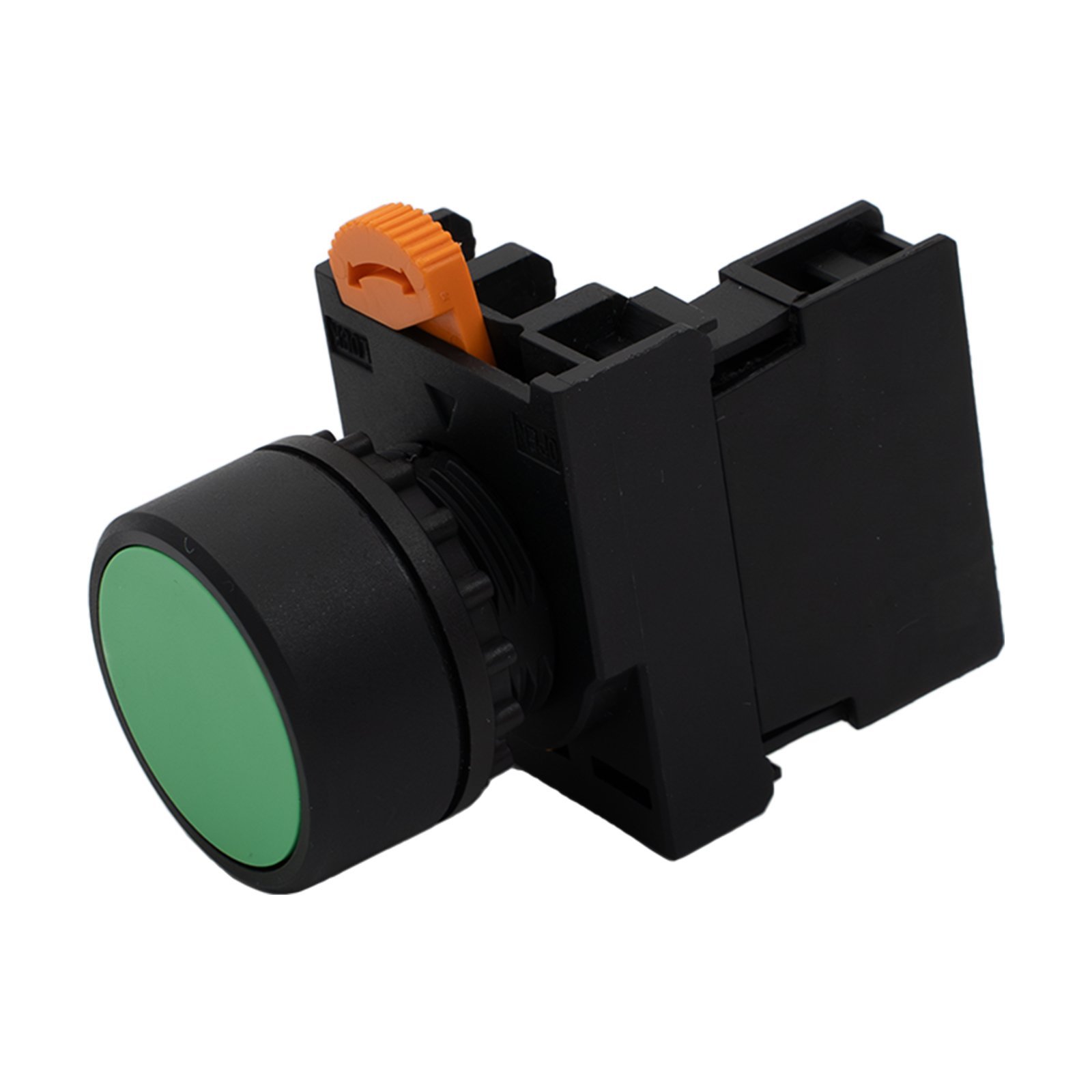
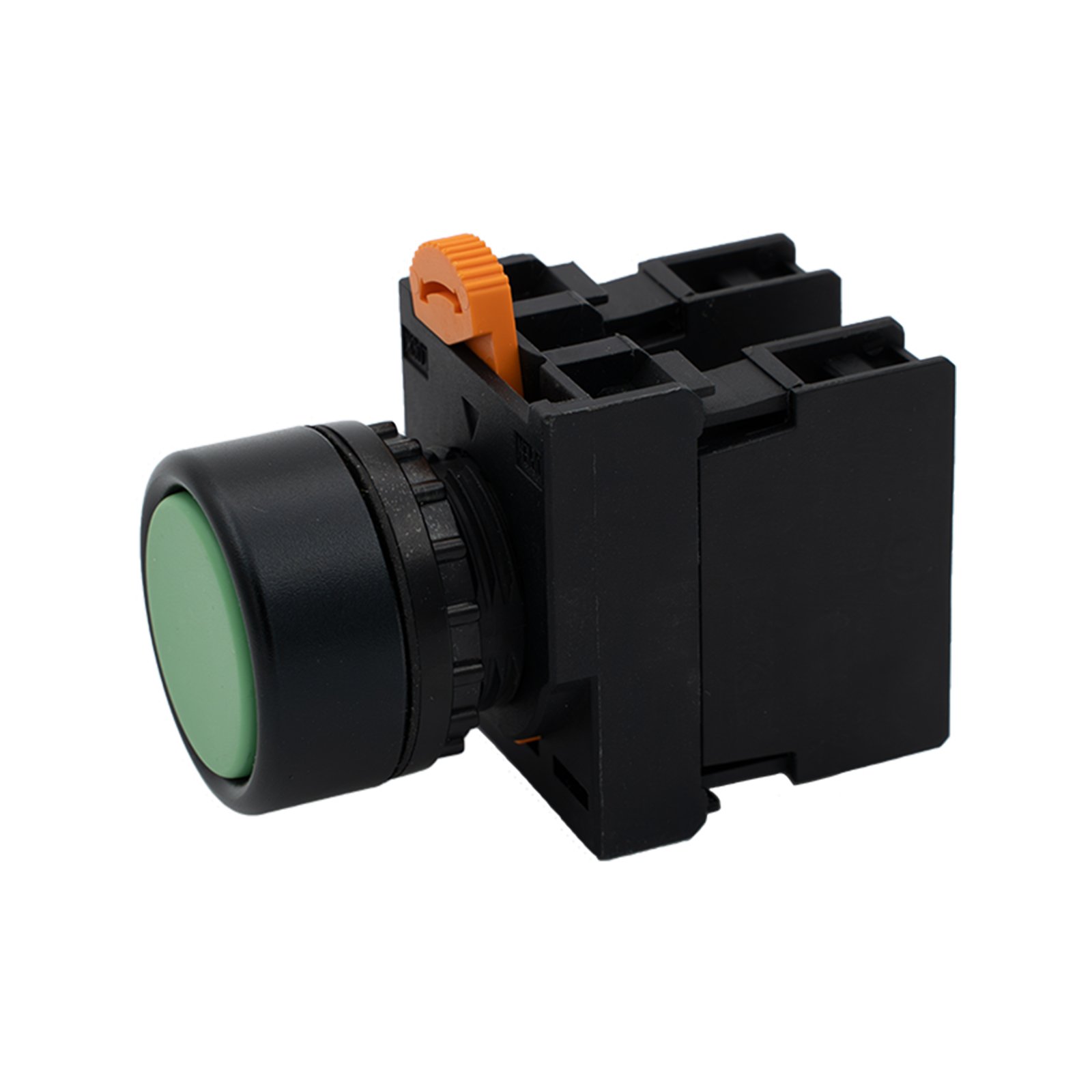
That is the case for the gold option. Gold forms no oxide, so there is nothing for a low energy signal to break through, and it holds stable in dry circuit service indefinitely. It is soft and unsuited to high inrush, which is why we treat it as a signal material rather than an upgrade across the board. The XH2 range is offered with silver nickel alloy, plain silver, or gold plated silver nickel contacts, and the material goes into the box at order time. The test we apply is short: what voltage and what current does this contact see in service? Anything that ends in milliamps belongs on gold. For low current logic duty our 1NO momentary mushroom head push button is one we regularly ship on gold rather than silver. Model codes for each contact material are listed in the XH2 and LA135 catalogues on the downloads page.
One maintenance engineer described the symptom better than any datasheet manages. His machine, he said, worked when it wanted to. That is precisely what intermittent contact film looks like from the operator’s side of the door.
Two mechanical causes that wear the same costume
A worn block can still feel healthy. The click a finger feels comes mostly from the actuator head mechanism, not from the contacts changing state, so a crisp click says little about the back of the assembly. Once the internal spring loses force, the plunger travels without enough pressure left to close firmly, and pressing harder fixes that press and not the next one.
Assembly is the other culprit. A contact module that never seated fully on its mounting frame leaves the actuator a millimetre short of home. It goes together by hand, passes on the bench, and misbehaves under vibration on the machine. On the XH2 range the triangular marks on head and frame line up when the assembly is right, and checking takes a second. Where the block itself has worn out, swapping just the block beats replacing the whole device, and spare blocks are listed alongside the complete units under push button switches.
The six in the morning pattern
Intermittent film has a favourite time of day. Humidity is the driver, and our XH2 range is declared for up to 95 per cent relative humidity at 25 degrees Celsius, non condensing. Condensation breaks that condition. Overnight the panel drifts close to dew point. First shift starts with damp contacts. By ten o’clock everything has warmed and the fault is gone. Failures bunched around the first start of the day point at the cabinet, not the button. Heaters or a breather usually fix it. A new switch does not. Our earlier piece on sizing anti condensation heating for cabinets works through the numbers if that pattern matches yours.
Send us a case like this and the four facts we need are what the contact switches, at what voltage, roughly what the input draws, and whether a relay sits in between. Those four answers usually pick the correct part on the first pass.
The meter, for what it is worth, never lied that Monday. It answered its own question, with its own current, and gave the honest answer to that. Ask what the input sees with the circuit live instead, and a machine that works when it wants to turns back into an ordinary part number, wearing the right plating for the job.